

En esta noticia
The United States Transportation Security Administration (TSA) has rules that govern which objects passengers may carry in their suitcases and what checks they must pass before boarding an airplane. Federal regulations establish inspection procedures to detect dangerous items and prevent them from reaching an aircraft.
During these checks, each piece of baggage goes through scanners that allow its contents to be examined. If agents detect something that requires additional review, they may open the suitcase and inspect it physically, even without its owner’s presence.
The rules vary depending on the item and type of baggage, which is why knowing the current rules allows one to identify which objects are prohibited, which are restricted, and in what circumstances the TSA may remove them during an inspection.
What rules require the TSA to inspect passengers’ suitcases at airports in the United States
The TSA is responsible for screening passengers’ baggage before it is transported on commercial flights. This obligation is set forth in Title 49 of the United States Code, section 44901 (49 U.S.C. § 44901), which establishes that the agency must provide for the inspection of passengers and their belongings, including carry-on and checked baggage. The same provision requires that there be a system for screening all checked suitcases at U.S. airports.
The regulation also provides for the use of explosive detection systems and other screening methods, such as X-ray scanners and physical inspections that may or may not be random.
When can the TSA open suitcases during security checks
Although electronic screening allows baggage to be checked without opening it, the TSA may carry out a physical inspection when it needs to verify what the suitcase contains. According to the agency itself, if a piece of baggage triggers an alert during screening, agents may open it to examine the objects shown in the scanner image. If the baggage is locked and cannot be opened by other means, the lock may have to be cut off.
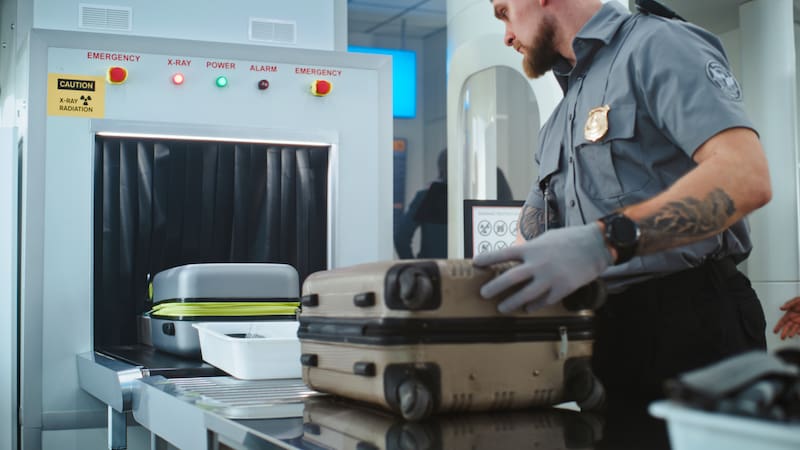
When a physical inspection is carried out, the TSA indicates that it may leave inside the suitcase a notice called Notice of Baggage Inspection, which informs the passenger that their baggage was opened and inspected. In this sense, this may occur even if the owner is not present at that time.
The procedure applies to each piece of baggage that requires additional review. For example, if three different suitcases trigger alerts that cannot be resolved by analyzing the images, each one may undergo a physical inspection.
What prohibited items can the TSA remove from suitcases during security checks
Restrictions on objects that may be carried on an airplane depend on the type of item and whether it is in carry-on or checked baggage. One of the central rules is 49 CFR § 1540.111, entitled Carriage of weapons, explosives, and incendiaries by individuals, which regulates the transport of weapons, explosives, and incendiary devices.
The provision states that unloaded firearms may be transported in checked baggage only if specific requirements are met, such as declaring them to the airline, storing them unloaded in a locked hard-sided case, and complying with the other applicable conditions. Loaded weapons and unauthorized explosives or incendiary devices may not be transported in checked baggage.
In addition, the TSA publishes an official list that allows passengers to check which items are permitted and which are restricted:
- Knives and sharp objects are generally not allowed in carry-on baggage, but may be transported in checked baggage if properly protected.
- Explosives and fireworks: not allowed in carry-on or checked baggage.
- Power banks and spare lithium batteries: portable chargers (power banks) and spare lithium batteries must be carried in carry-on baggage, not in checked baggage. Electronic devices with installed batteries have specific rules.
- Liquids, gels and aerosols: in carry-on baggage, the general rule limits containers to 100 milliliters (3.4 ounces), with exceptions for certain items. Other conditions apply to checked baggage.
It should be noted that if, during an inspection, agents find an object that is not allowed under those conditions, they may prevent it from being transported and proceed according to the applicable rules. The TSA also warns that certain items may require additional screening or may not be admitted if they trigger an alert or raise a security concern.