
En esta noticia
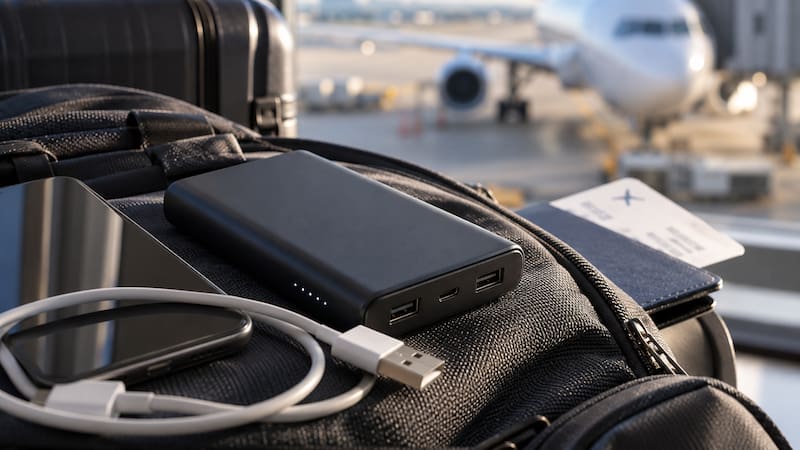
Portable chargers for cell phones are one of the most used accessories by travelers, as they allow electronic devices to be recharged without needing to be plugged into an outlet. However, there are restrictions on how they may be transported during a flight.

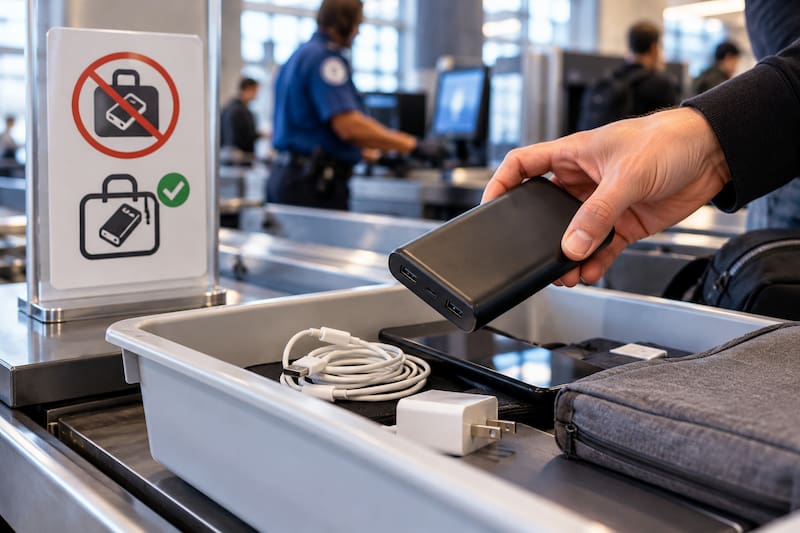
The Federal Aviation Administration of the United States (FAA) states that external batteries, also known as power banks, cannot be carried in checked baggage because of the risk of overheating and fire posed by lithium batteries.
According to the FAA on its official website, these accessories must be carried in carry-on baggage and meet certain capacity limits in order to travel by plane.
Why is it prohibited to carry portable chargers in checked baggage?
Lithium-ion batteries used by many portable chargers can overheat and undergo a phenomenon known as thermal runaway, which can cause smoke, fire, or an inferno.
According to the FAA, this situation can occur when a battery is damaged, overheats, comes into contact with water, receives an excessive charge, or is not properly protected. It can also happen because of manufacturing defects.
For this reason, spare batteries and portable chargers must remain in the airplane cabin, where the crew is prepared to identify and respond to possible incidents.
The aviation authority also recommends immediately notifying flight personnel if a battery begins to heat abnormally, swell, emit smoke, or catch fire.
Which portable batteries can be carried in carry-on baggage?
The FAA establishes different conditions depending on the battery capacity, which is measured in watt-hours (Wh).
- Up to 100 Wh: Portable batteries are allowed in carry-on baggage, provided they meet the corresponding safety conditions.
- Between 101 and 160 Wh: Airline approval is required, and a maximum of two spare batteries per passenger is allowed.
- More than 160 Wh: Portable batteries of this capacity are not allowed on passenger aircraft under the FAA’s general rules.
The agency clarifies that airlines may set additional restrictions on the number of portable chargers and their capacity. Therefore, it recommends checking the airline’s conditions before traveling.
How should a portable charger be properly carried during a flight?
To reduce risks, the FAA recommends that lithium batteries be protected against damage and short circuits.
Among the measures passengers should keep in mind are:
- Keep the portable charger in carry-on baggage, never in checked luggage.
- Check its capacity, expressed in watt-hours (Wh), to verify that it meets the allowed limits.
- Protect the battery terminals to avoid accidental contact with metal objects that could cause a short circuit.
- Check the airline’s conditions, as some companies apply stricter limits.
- Remove the charger from the suitcase if it must be checked at the boarding gate, and keep it in the cabin.
In addition, damaged, defective, or recalled batteries due to safety issues must not be transported on the plane because of the risk of overheating or fire.