
En esta noticia
When driving on the road, there are many signs to recognize so you know how to respond to them. In this sense, it is not only the signs indicating detours or restrictions that matter, but also the markings that may be painted on the pavement.
The Manual on Uniform Traffic Control Devices (MUTCD) distinguishes among three types of lines: solid lines, broken lines, and dotted lines. Each has a different meaning, which can vary depending on the color or possible combinations.
What do solid road lines mean?
According to Section 3A.04 of the U.S. MUTCD, solid lines are used to discourage or prohibit drivers from crossing them, depending on their specific application.
Solid lines help organize traffic and set restrictions in certain sections of the road.
When they appear as double lines, they indicate maximum or special restrictions on that stretch of road.
How are they different from broken lines?
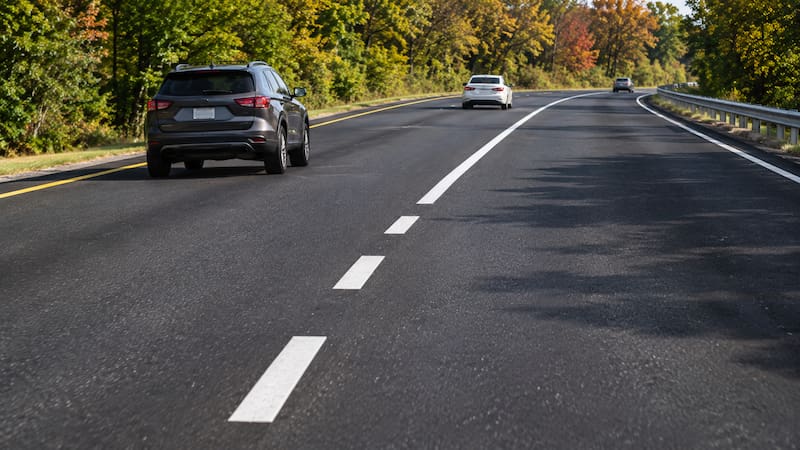
Broken lines indicate that crossing them is allowed, as long as traffic conditions and traffic laws permit it. According to the MUTCD, these markings are made up of standard-width segments separated by predetermined gaps:
- Length of each segment: 10 feet (3.05 meters).
- Gap between segments: 30 feet (9.14 meters).
These dimensions can be adjusted while keeping similar proportions, depending on traffic speed and signage needs.
What are dotted lines and what do they indicate?
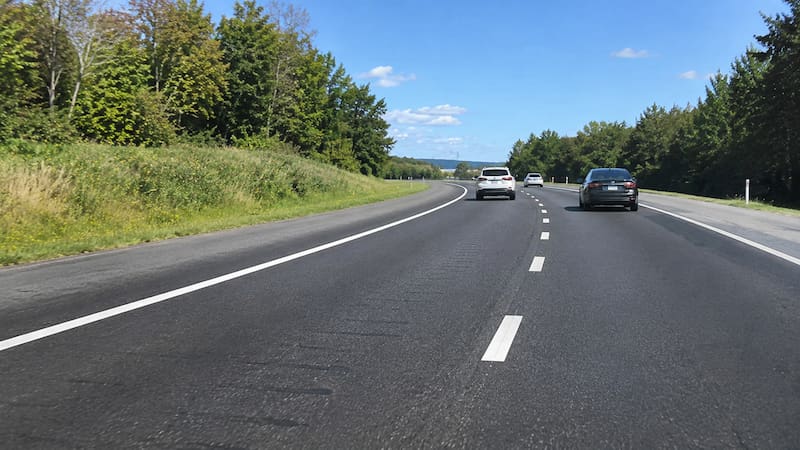
Dotted lines are marked by shorter segments and spaces than conventional broken lines.
According to the MUTCD, they serve two main purposes:
- To warn of upcoming changes in a lane’s function, such as when a lane ends or changes use.
- To guide drivers through intersections, transition areas and freeway entrance or exit ramp areas.
How are the different colors used?
According to the MUTCD, the color of painted pavement markings indicates their function, and knowing what they mean helps keep traffic moving in an orderly way:
- White: used to separate lanes traveling in the same direction and to mark the right edge of the roadway.
- Yellow: used to separate traffic moving in opposite directions and to mark the left edge of certain roads.
- Red: used in specific markings to indicate traffic restrictions or areas that should not be entered.
- Blue: used alongside white lines to identify parking spaces reserved for people with disabilities.
- Purple: may complement certain lane markings to identify routes used by vehicles with electronic toll collection systems.
How can these lines be found on roads?
The so-called “longitudinal markings” can be identified by their shape, color, and location on the pavement.
- Solid: an unbroken line.
- Double: two parallel lines separated by a gap. Both may be solid, both broken, or one of each type.
- Broken: relatively long dashes separated by wider gaps.
- Dotted: short dashes separated by short gaps.