
En esta noticia
NASA Earth Observatory has updated the latest discoveries about the sea ice growth in Antarctica. Scientists track long-term change on Earth’s surface through satellite imagery.
Unlike the Arctic, which is an ocean surrounded by land, Antarctica is a continent encircled by the ocean. This allows sea ice to spread over a larger area during winter. However, because the ice extends into warmer latitudes, it melts more extensively during the summer.
Antarctic sea ice typically reaches its maximum extent in September, at the end of winter in the Southern Hemisphere, before shrinking to its lowest level in February.
NASA discovery: What to know about Antarctic Sea Ice growth
Antarctic sea ice likely reached its annual maximum on September 14, 2026, covering approximately 17.59 million square kilometers (6.79 million square miles), according to NASA and the National Snow and Ice Data Center (NSIDC). This marked the third-lowest maximum extent recorded since satellite monitoring began.
The annual maximum marks the point when sea ice reaches its greatest extent during the Southern Hemisphere’s winter, before retreating as temperatures rise. Scientists monitor these seasonal changes to better understand long-term trends in Antarctic sea ice and how the region is responding to changes in climate.
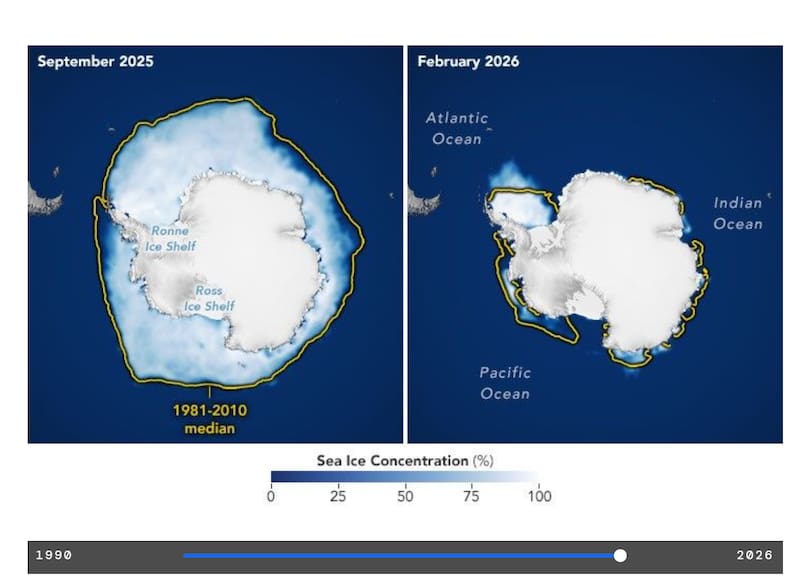
The maps show how Antarctic sea ice concentration changed between September, when it typically reaches its annual maximum, and February, when it usually retreats to its minimum. Comparing the 2025 and 2026 images helps illustrate the seasonal differences in sea ice coverage, with white areas indicating higher ice concentrations and dark blue representing open water.
Why Antarctic sea ice expand in winter and retreat in summer
Antarctic sea ice follows a seasonal cycle, expanding as temperatures drop during the Southern Hemisphere’s winter and retreating as temperatures rise in summer. It typically reaches its maximum extent in September, near the end of winter, before shrinking to its minimum in February.
The continent’s geography also plays a role in this cycle. Unlike the Arctic, which is an ocean basin surrounded by land, Antarctica is a continent surrounded by ocean. This gives sea ice more room to expand during winter, but it also allows the ice to extend into warmer latitudes, where more melting occurs during summer.