
En esta noticia
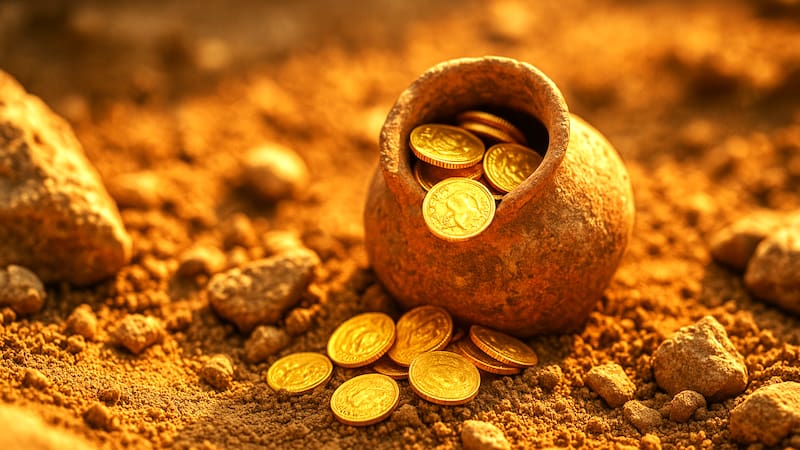
A team of archaeologists found in France a treasure with tens of thousands of Roman coins that had remained hidden for 1,800 years. The discovery was made in the village of Senon, in the northeast of the country, during excavation work ahead of construction. According to the first estimates, the total number could exceed 40,000 pieces.
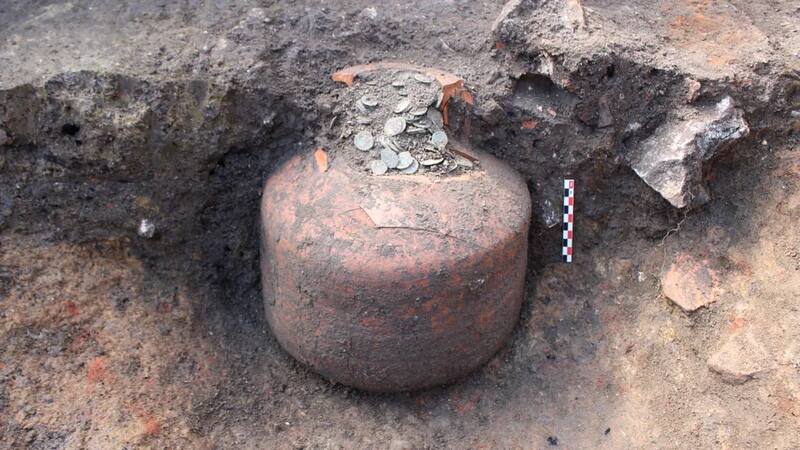
The discovery was confirmed by the French National Institute for Preventive Archaeological Research (INRAP), which was in charge of the excavation. The coins were distributed in three ceramic vessels known as amphorae. Specialists estimate that they were buried between the years 280 and 310 AD.

Where was the Roman coin treasure found?
The find took place in a residential neighborhood of ancient Senon, a settlement that evolved from a Gallic village into a Roman city. The excavation covered 1,500 square meters and made it possible to reconstruct different stages of life at the site. There, paved streets, stone houses, and underfloor heating systems were identified.
The three amphorae were buried inside a house, with their mouths at floor level to make access easier. That arrangement allowed archaeologists to calculate precisely the number of coins in each one. The results were based on the total weight of each vessel.
How many coins were in each vessel
The breakdown by amphora shows the magnitude of the find:
- First amphora: 38 kilos, between 23,000 and 24,000 coins.
- Second amphora: 50 kilos, between 18,000 and 19,000 coins.
- Third amphora: only 3 coins, as it had been removed in ancient times.
What does this find reveal about the Roman Empire?
For specialists, the coins were not a treasure hidden for safety, but a household savings system. That hypothesis is supported by the fact that some pieces remained stuck to the rim of the vessels. This detail indicates that coins were regularly deposited and withdrawn.
The coins bear the image of the emperors Victorinus, Tetricus I and Tetricus II, leaders of the so-called Gallic Empire. That territory broke away from Rome between the years 260 and 274 AD. A fire destroyed Senon at the beginning of the 4th century and the site remained abandoned for centuries.


What happens now with the found coins
Under French law, the treasure became property of the State and the pieces were transferred for cleaning and numismatic analysis. Since the excavation was related to a home expansion, INRAP first digitized the discovered neighborhood in 3D. With that complete record, the site has already been filled in and returned to its owner.