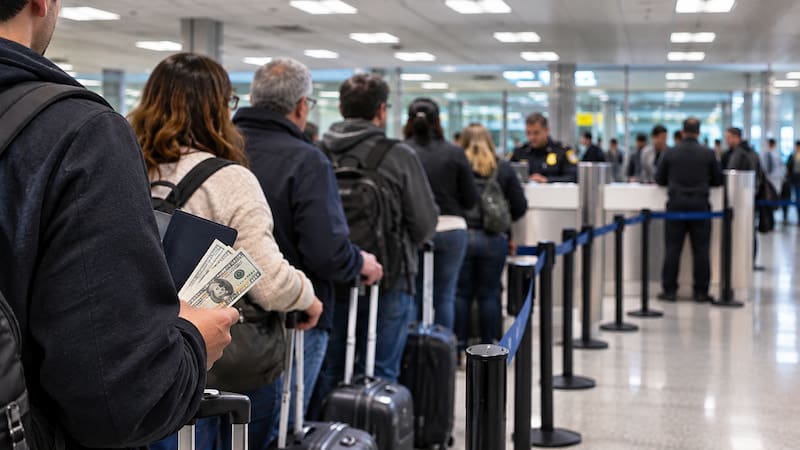

Families entering or leaving the United States with more than $10,000 in cash or other monetary instruments must declare the money to customs authorities. The requirement also applies to individual travelers who exceed that amount.
According to the U.S. Customs and Border Protection (CBP), the money must be reported on FinCEN Form 105 when the threshold set by federal regulations is exceeded.
The agency says there is no maximum amount of money that can be carried into or out of the country. However, failing to meet the declaration requirement can lead to legal consequences.

U.S. Customs: How does the US$10,000 limit apply to families?
CBP says that when members of a family travel together and file a joint customs declaration, the money carried by the group is counted together to determine whether the $10,000 threshold has been exceeded.
That means the limit should not be interpreted as $10,000 per family member traveling under a joint declaration.
What happens if a family does not declare more than $10,000 in cash?
Failing to file the required declaration can have serious consequences. U.S. authorities may hold or seize the undeclared money, in addition to imposing civil penalties and, in some cases, criminal penalties.
To comply with the rules, anyone entering or leaving the United States with more than $10,000 in cash or other monetary instruments must file FinCEN Form 105. When entering the country, funds must also be declared to CBP through the applicable customs procedures.
The declaration does not mean the money is illegal or that it is prohibited to travel with amounts above $10,000. The requirement is simply to properly report the funds being carried when the threshold is exceeded.
For that reason, before traveling, families should total the money they are carrying and check whether they need to file a declaration with U.S. Customs.