
En esta noticia
An Australian vessel set a world record for speed on water of 318 mph in 1978, a number that remains unbeaten in 2026. The Spirit of Australia remains to this day a challenge for those trying to understand naval engineering.
That achievement was possible thanks to a jet engine originally designed for fighter jets and adapted to operate in the vessel. To this day, the boat can be seen at the Australian National Maritime Museum.

How does the fastest vessel in the world work?
Its operation is very different from that of a conventional speedboat. It does not use propellers; instead, it uses a Westinghouse J34 jet engine, one that was originally designed for military aircraft in 1940. This generates the thrust needed to propel it across the water’s surface.
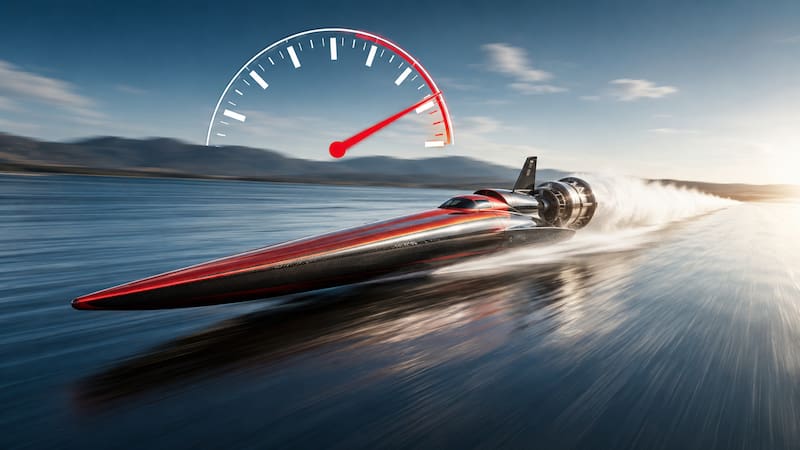
The hull was designed to minimize contact with the water. At more than 318 mph, the vessel practically “flies” over a thin layer of air and water, reducing friction and allowing extreme speeds to be reached.
The engine draws in large amounts of air, compresses it, and expels it at extremely high speed through the rear, generating the thrust needed to accelerate across the water’s surface.

Who built it?
The person behind this engineering masterpiece was Ken Warby. He designed and built the vessel from scratch in the backyard of his home in Sydney.
The engines used were obtained at auction and purchased for 265 Australian dollars. He later developed the hull using wood and fiberglass; the project was self-financed by him.
In addition, he was also the one in charge of driving it, so the record is doubly remarkable for being the first to survive such speeds on water.