
En esta noticia
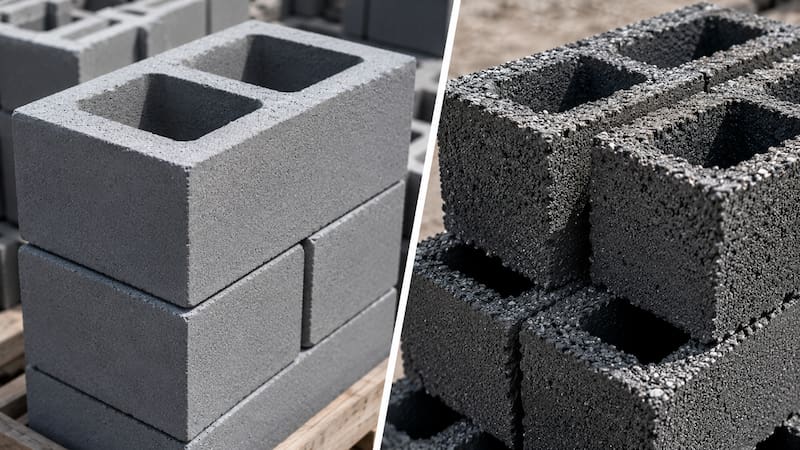
Although many people use the terms concrete block and cinder block as if they were synonyms, they are actually different construction materials. At first glance they may look almost identical, but their composition, strength, and durability have important differences that make each one more suitable for certain projects.
If you are about to carry out a project or a remodel in your home, knowing these differences can help you choose the right material and avoid mistakes that later turn out to be costly.

What is the difference between concrete blocks and cinder blocks?
The main difference lies in the materials used to make them.
Concrete blocks, also known as concrete masonry units (CMU), are made with Portland cement, water, sand, and dense aggregates such as crushed limestone or gravel. This combination results in a solid and durable block, whose weight can range between 13 and 25 kilos, depending on whether it is solid or hollow.
On the other hand, cinder blocks are made with coal waste (bottom ash) instead of stone or gravel. As a result, they are much lighter, with an approximate weight of 9 to 11 kilos, although they are also less dense and considerably less strong.
Which is better?
For most construction projects, concrete blocks are the better option.
Their more compact composition gives them a compressive strength close to 2,500 PSI, making them ideal for:
- Foundation walls.
- Load-bearing walls.
- Retaining walls.
- Structural construction.
- Outdoor projects that require greater durability.
By contrast, cinder blocks are not recommended for structural applications, since they do not support the same load or pressure. Their use is more appropriate for lightweight construction or elements that do not need to bear weight.
Moisture resistance also makes a difference
Another important advantage of concrete blocks is their greater resistance to moisture.
Cinder blocks are much more porous, so they absorb water more easily. In areas with low temperatures, that moisture can freeze and expand, causing cracks and deterioration over time.
Concrete blocks, being denser, offer better protection against water. However, when they are used in foundation walls below ground level, it is still advisable to apply waterproofing systems to prevent moisture problems.

Are cinder blocks still sold?
In most cases, no.
True cinder blocks practically stopped being mass-produced after World War II, when the use of coal-fired plants declined and the industry began manufacturing stronger and more efficient concrete masonry units.
Today, if you buy blocks at a building materials store or a major home improvement chain, you are most likely buying concrete blocks, even though many people continue to call them “cinder blocks.”
However, if you are remodeling a home built before the 1970s, it is still possible to find original cinder blocks. In those cases, it is important to identify them by their lighter weight, rougher texture, and darker color before carrying out structural repairs or remodels.
Which one should you choose?
If your project needs to bear weight or ensure a long service life, concrete blocks are clearly the better alternative. Their greater strength, durability, and ability to withstand moisture make them the standard in modern construction.
Cinder blocks can still be useful for some decorative projects or low-demand DIY jobs, but their lower strength and greater porosity make them a less reliable option for structural construction.