
En esta noticia
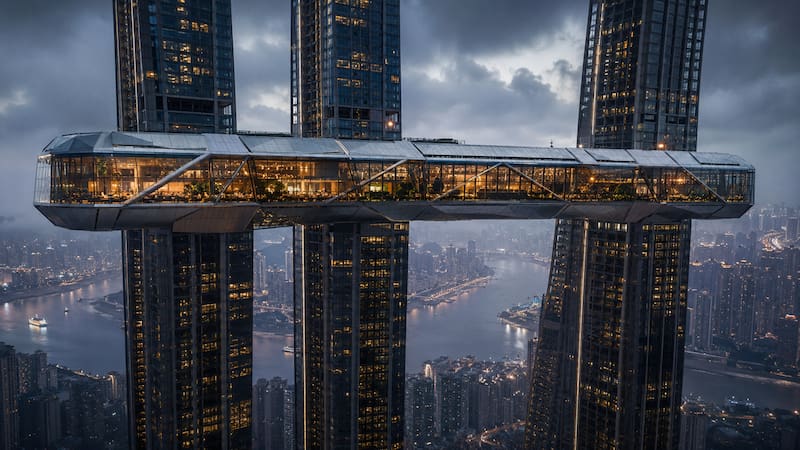
In the Chinese city of Chongqing, a horizontal skyscraper stretching 300 meters and weighing 12,000 tons floats 250 meters above the ground, connecting four towers. The structure, called The Crystal, weighs as much as the Eiffel Tower —although, unlike it, it does not touch the ground.
It is part of the Raffles City Chongqing complex, developed by CapitaLand and designed by Safdie Architects, the firm behind Marina Bay Sands in Singapore. With more than 10,000 square meters of interior space, it is not just a bridge between towers: it is an entire city suspended in the air.

How was a 12,000-ton horizontal skyscraper built 250 meters above the ground?
The biggest challenge was not the design, but the assembly. To avoid assembling the structure at full height, the engineers built three central sections at ground level and raised them with chain hydraulic jacks: synchronized lifting systems capable of operating with millimeter precision.
Each section weighed up to 2,400 tons and had to fit exactly into the connection points of the towers, exposed to wind and river fog. The exterior was clad with nearly 3,000 glass panels and almost 5,000 aluminum panels, integrated into a folded structural frame that defines its faceted façade.
What is inside the horizontal skyscraper and why is Chongqing now a global architecture benchmark?
The Crystal includes restaurants, bars, gardens, a hotel lobby, and a private club with a 50-meter infinity pool. Its main attraction is a 1,500-square-meter transparent glass-floored terrace: from there, visitors look directly down onto the streets 250 meters below.

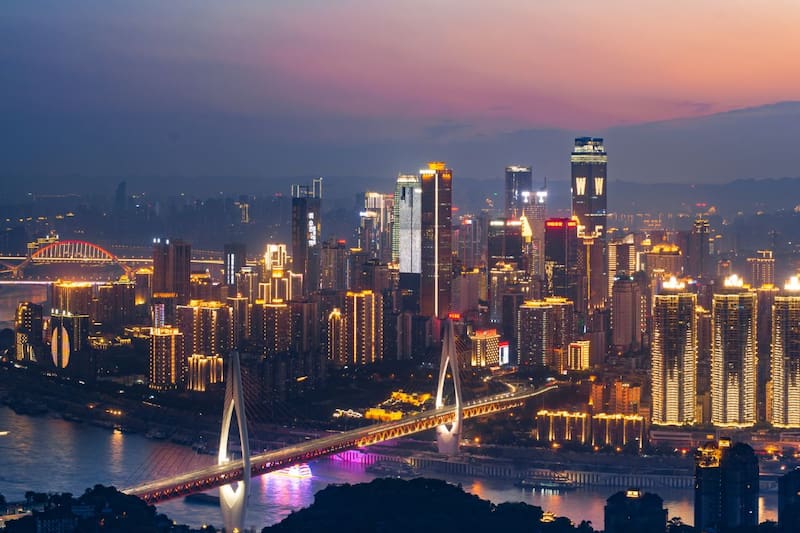
The entire complex —offices, hotel, apartments, and shops— required a US$3.4 billion investment and exceeds 1,120,000 square meters of built area. In a megalopolis of 31 million inhabitants with limited land and mountainous terrain, The Crystal proves that the architecture of the future does not only grow upward: it can also stretch out and inhabit the sky.