
En esta noticia
The white stains and buildup that, over time, appear on bathroom and kitchen faucets are one of the most annoying cleaning problems: They do not come off with a simple cloth and keep coming back.
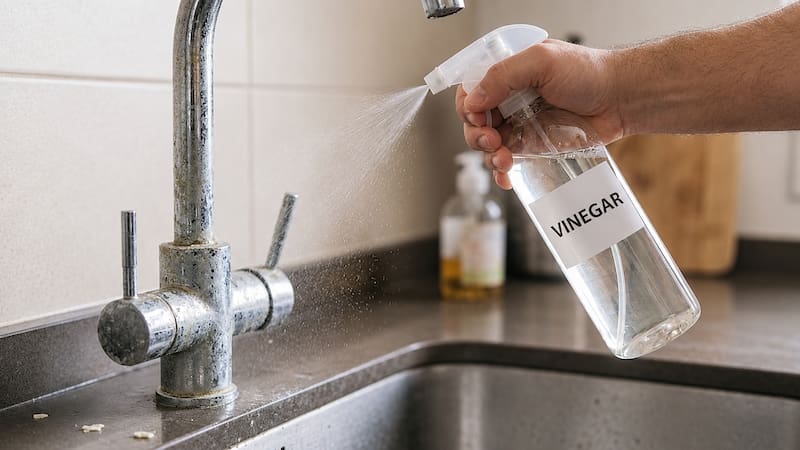
That is why a home remedy that tackles them at the source and with little effort has grown popular: spraying vinegar on faucets. It is not a random idea; it has a clear chemical explanation.
What Spraying Vinegar on Faucets Is Good For
Spraying vinegar on faucets helps remove limescale and calcium stains, that white or grayish crust that forms around the faucet, at the base and at the water outlet. It also helps restore shine, since those deposits are what dull the metal. It is a way to clean and remove buildup from faucets without having to scrub hard or use abrasive products that could scratch them.
The trick does not just cover up the stain: it dissolves it. That white crust is actually limescale, or calcium carbonate, a mineral that hard water, which is rich in calcium, leaves behind on surfaces as it dries. Vinegar, for its part, contains acetic acid, a mild acid that reacts with calcium carbonate and breaks it down.
When applied, the acid attacks the scale, softens it and loosens it from the metal, so it can later be wiped away with a simple cloth, without any scraping. That is why the faucet is left smooth and shiny again.
Step by Step: How to Make the Mixture at Home
The process is very simple:
- Mix white vinegar with a little water in a spray bottle (pure vinegar can be used for tougher buildup).
- Spray directly onto the faucet, covering the areas with white stains and the water outlet well.
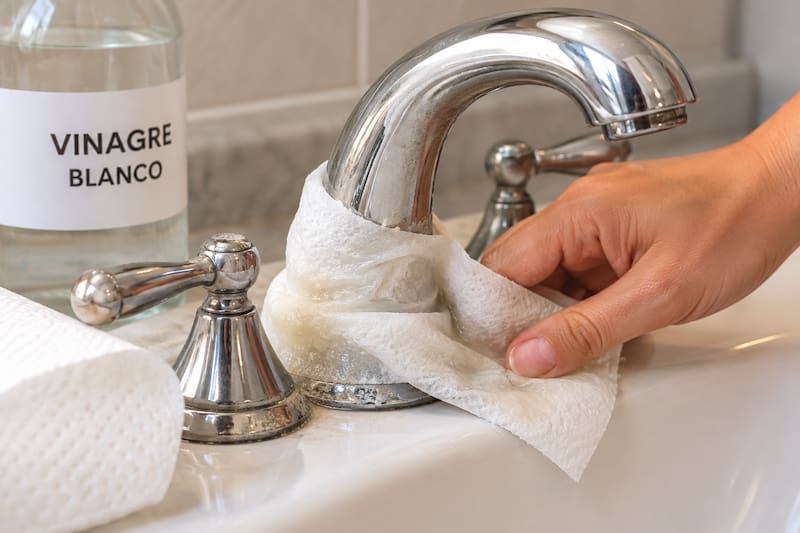
- For more stubborn scale, it helps to wrap the faucet with a cloth or paper towel soaked in vinegar and let it sit for a few minutes so the acid has time to soften the deposit.
- Remove it with a cloth, gently rubbing; the loosened scale comes off easily.
- Rinse with water to remove any vinegar residue and dry with a clean cloth so no new water spots are left behind.

Why It’s Recommended
Beyond the results, the appeal is twofold. On the one hand, it is cheap and natural: It uses an extremely inexpensive product that almost everyone has in the kitchen instead of commercial limescale cleaners.
On the other hand, it is convenient, because it does the work almost on its own: You apply it, let it sit and wipe it away, without the effort of scrubbing away a hard crust. On top of that, it avoids spraying harsh chemicals in places like the kitchen or bathroom, where a gentler clean is preferred.