
En esta noticia
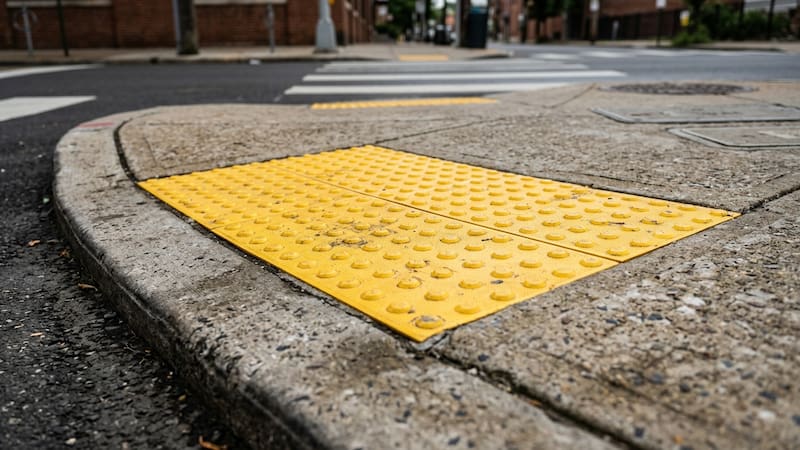
The yellow bumps with raised dots seen at street corners serve a function that goes far beyond the aesthetic. These surfaces found in numerous cities in the United States are part of urban accessibility infrastructure and are designed to warn people with visual disabilities of possible hazards.
Known as tactile paving or detectable warning surfaces, they make it possible to recognize through the touch of the feet or the white cane that one is reaching the edge of the sidewalk or a vehicular traffic area.

They help identify the moment when it is necessary to stop, pay attention to the surroundings, and assess whether it is safe to cross.
In the United States, these surfaces are covered by federal accessibility rules and guidelines. The Americans with Disabilities Act (ADA), the law that protects the rights of people with disabilities, sets standards to improve accessibility, while the U.S. Access Board develops technical guidelines for public pedestrian spaces.
What do the yellow bumps with dots at the corners mean?
Bumps with raised dots are tactile warning signals; their presence indicates that the pedestrian is approaching an area where special attention must be paid, such as the meeting point between a sidewalk ramp and the roadway.
According to the accessibility standards published by the United States Department of Justice at ADA.gov, these surfaces must have a texture formed by truncated domes and meet specific measurements.
Section 705 of the 2010 standards establishes that the raised portions must be approximately 5.1 millimeters high, in addition to having specified diameters and distances between them.
It requires the surface to visually contrast with the pavement around it, whether through a light-on-dark or dark-on-light combination.
That is why, although yellow is a common color on these tiles, it is not the only one allowed by those standards, since what matters is that there be visual contrast where the texture and the arrangement of the dots are essential for the warning to be recognized by touch, even when the person cannot distinguish colors or see the surface.
What are tactile paving tiles for, and how do they help people with visual disabilities?
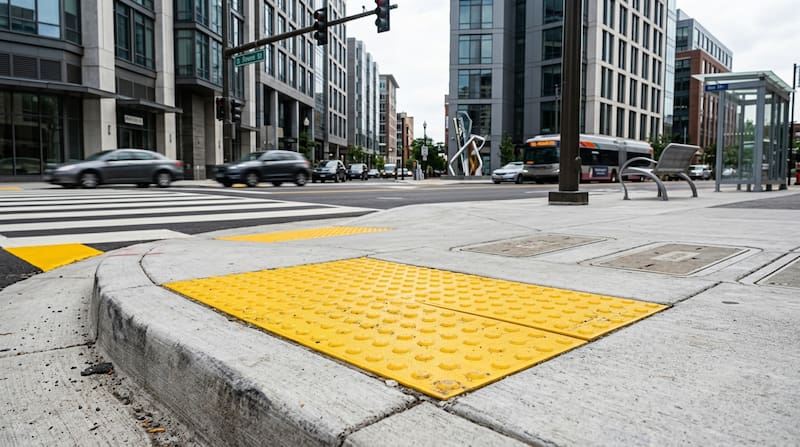
The function of these tiles is to warn blind people or those with low vision that they are approaching a dangerous transition, especially when the sidewalk descends to street level. By detecting the raised surfaces with their feet or with the white cane, they can recognize that they are approaching the crossing and take precautions before moving forward.
The signal is important at corners with ramps, because these eliminate the difference in level that traditionally separated the sidewalk from the roadway. Without a clear tactile warning, it can be more difficult to identify where the pedestrian area ends and the area used by vehicles begins.
The U.S. Access Board explains that these surfaces provide a distinctive texture to warn of the proximity of vehicular areas and other hazards, such as the edges of train platforms.
However, the tiles do not indicate when to cross or replace other safety measures, such as pedestrian signals, audible signals, or attention to traffic, since their purpose is to provide an additional signal so that people can move around with greater independence.