
En esta noticia
White vinegar is one of the most commonly used products for household cleaning because of its low cost and versatility.
However, studies on its benefits go beyond removing stains and eliminating some odors: scientific research analyzed the ability of acetic acid to combat certain fungi and microorganisms.
The study, published in the journal BMC Microbiology, evaluated its effectiveness at different concentrations and under laboratory conditions.
The results provide evidence of its antifungal and antimicrobial properties.

White vinegar for cleaning the house: what the scientific study says
The research was published on August 26, 2020 in the journal BMC Microbiology and was led by researchers Marc-Kevin Zinn and Dirk Bockmühl.
The objective was to study the activity of acetic acid against bacteria, fungi and certain viruses, beyond evaluating its possible application in household cleaning procedures and laundry washing.
The results showed that formulations with a concentration of 10% acetic acid and 1.5% citric acid achieved a reduction of more than five orders of magnitude in several of the bacteria and fungi analyzed, according to the criteria of the tests used.
In the surface tests, a reduction of more than five orders of magnitude was also observed in different microorganisms, including the fungus Aspergillus brasiliensis, with an acetic acid concentration of 5%.
The study also analyzed antiviral action
The research evaluated the activity of acetic acid against the modified vaccinia Ankara virus (MVA), used as an experimental model.
The tests showed a reduction of at least four orders of magnitude when acetic acid concentrations of 5% or higher were used.
The researchers used a solution prepared with high-purity acetic acid diluted in water, in concentrations between 5% and 10%. It is worth noting that conventional white vinegar sold in stores usually has an acetic acid concentration of around 4% or 5%
What the research concluded about white vinegar
In addition to the tests on surfaces and in suspension, the researchers analyzed the effect of acetic acid during a simulated laundry wash cycle and found considerable antimicrobial activity under the conditions evaluated.
The main conclusion was that acetic acid can act against certain fungi, bacteria and viruses, but its effectiveness depends on the concentration and the formulation used.
It is worth noting that in the tests, effectiveness increased when higher concentrations were used and, in certain tests, when the compound was combined with citric acid.

White vinegar for basic cleaning: what surfaces can be cleaned
For everyday, superficial cleaning, white vinegar can be used on some acid-resistant surfaces, provided the manufacturer’s instructions allow it.
Among the options are:
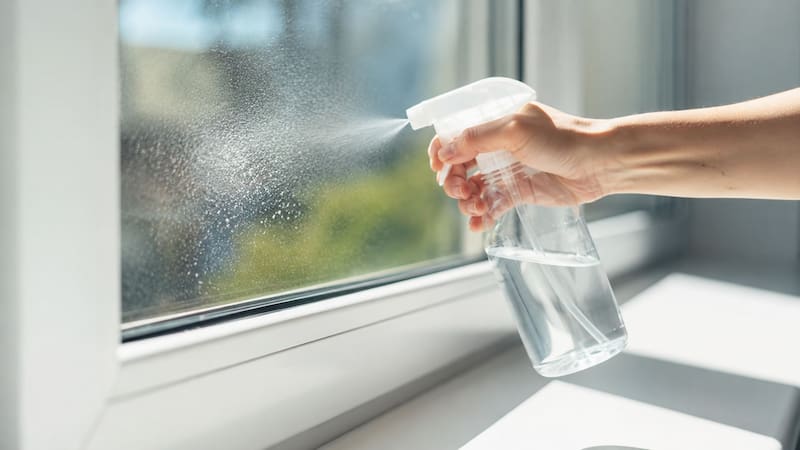
- Glass: to remove marks and surface dirt.
- Ceramic tiles: on surfaces compatible with acidic products.
- Some plastic surfaces: as long as the material can withstand this type of cleaning.
- Stainless steel: only if the manufacturer’s instructions allow the use of vinegar.