En esta noticia
The drains in the kitchen, bathroom, and other areas of the home can build up food scraps, grease, soap, and dirt over time. To keep them clean, there is a popular home trick: combining vinegar and baking soda.
The mixture is often recommended as a simple alternative for periodic pipe cleaning and to help reduce certain odors. However, although both products are common in household cleaning, it is important to know what this combination can really do and what its limitations are.
What is pouring vinegar and baking soda down the drain for?
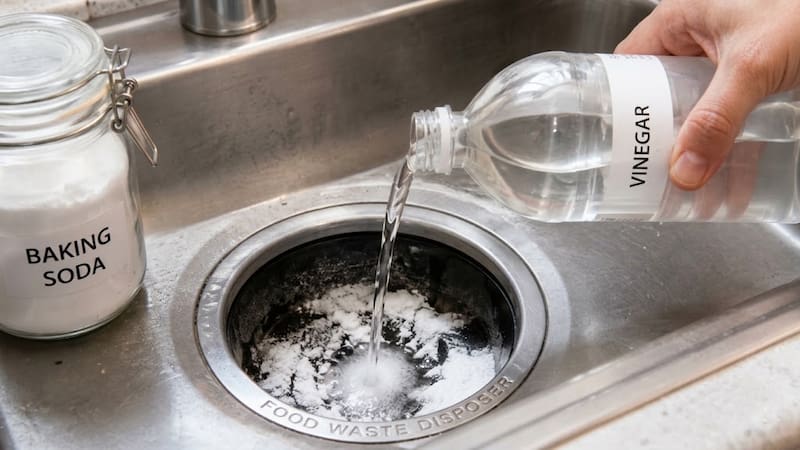
Baking soda and vinegar react immediately when they come into contact. Baking soda is an alkaline substance, while vinegar contains acetic acid, so when mixed they produce a chemical reaction that creates effervescence.
That reaction can help loosen surface dirt and residue around the drain opening. It can also help reduce some unpleasant odors associated with the buildup of residue.
For this reason, many people use both products as part of a preventive drain cleaning, especially in the kitchen and bathroom.
However, the effervescence that is observed does not mean the mixture has the ability to remove any clog. When there is a significant blockage caused by hardened grease, hair, solid residue, or other materials, the procedure may be insufficient.
How to use vinegar and baking soda to clean the drain
For those who want to try this method as a household cleaning, one of the most common ways is first to remove the visible residue from the drain area.
Then, a small amount of baking soda can be placed inside the opening and vinegar added. The reaction will begin immediately and produce foam and bubbles.
Once the reaction subsides, the drain can be rinsed with hot water, always taking into account the recommendations of the pipe and sink manufacturer.
The main objective is to help remove surface residue and keep the area clean, not necessarily to solve a severe blockage.
Do vinegar and baking soda really unclog pipes?
Although it is one of the most widely used cleaning tricks, it is worth distinguishing between cleaning a drain and unclogging a completely blocked pipe.
When vinegar and baking soda react, much of their original properties are neutralized. The effervescence can produce a limited mechanical effect on some residue, but it does not turn the mixture into a product capable of dissolving any type of blockage.
Therefore, when a drain is draining slowly, it may be more effective to start by removing visible residue and use appropriate mechanical methods, such as a plunger. If the problem persists or the pipe is completely blocked, it may be necessary to seek professional help.
What precautions should be taken?
Although these are common household products, it is not advisable to mix vinegar with chemical drain uncloggers. Some commercial cleaners contain substances that can generate dangerous reactions when combined with other products.
It is also advisable to avoid using homemade mixtures without knowing the material of the pipes. In the case of an old installation, a recurring problem, or a significant blockage, the safest option is to consult the manufacturer’s instructions or a specialist.
The main usefulness of vinegar and baking soda in this context lies, therefore, in household and preventive cleaning, not in guaranteeing that any blocked pipe will work again.