
En esta noticia
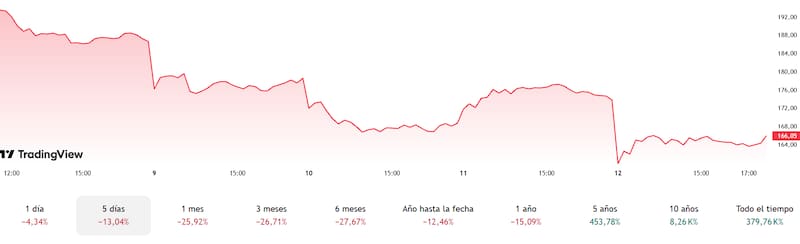
Shares of Nvidia, the leading company in semiconductors and computing for artificial intelligence, are having a rough week on Wall Street. Over the past few days, the stock has fallen more than 13%, deepening a pullback that now tops 30% from the all-time high it reached on Oct. 6, when it traded as high as $243.37 a share.
The decline took the stock to $166.19 at Thursday’s close, Nov. 12. The drop came amid a crisis that shook the company and ended with the resignation of Jensen Huang, its co-founder and CEO for 33 years, after allegations about his extramarital relationships surfaced.


In his place, the board named Colette Kress, who had been chief financial officer, as interim CEO. She will also remain in charge of finance while the company looks for a permanent successor.
Against that backdrop, investors are wondering what to do with their shares. In an interview with El Cronista, Gastón Lentini, a financial adviser and founder of Doctor de Tus Finanzas, analyzed which indicators to watch before making a decision.
What happened to Nvidia shares
The drop in Nvidia is not only about valuation. According to Lentini, part of the sell-off is tied to the uncertainty generated by Huang’s conduct and the doubts about the transparency of the information the company provides.
“Part of this correction has to do with the uncertainty created by the fact that the leader of the world’s biggest company lied to those closest to him,” the analyst said.
The adviser compared the situation with other trust crises that hit markets, such as Enron and Bernard Madoff, which ended in major frauds. The concern, he explained, is not just a executive’s private life, but the effect his actions can have on a company’s credibility.
“The answer is tied to the fact that, right now, we may not be able to trust that the company’s numbers are accurate,” he warned.
That factor adds to other risks the market is watching closely, such as possible U.S. restrictions on chip exports to China. In a company whose valuation depends heavily on the growth expectations for artificial intelligence, any sign that calls future revenue into question can affect its stock price.
Nvidia shares: Is it time to buy or sell?
Despite the size of the decline, Lentini believes Nvidia could be an investment opportunity for those with a long-term view. To back up his analysis, he recommends watching two indicators: P/E ratio and RSI.
The first relates a stock’s price to the company’s earnings and shows how much investors are willing to pay for each dollar of profit. According to the analyst, this indicator is at one of its lowest levels since 2019.
The second is the Relative Strength Index (RSI), a technical analysis tool that helps identify whether an asset is overbought or oversold. In this case, the indicator shows oversold levels, a signal that the company is cheap.
“I think the current drop represents an opportunity,” Lentini said. However, he added that that does not mean it is advisable to buy right away.
His recommendation is to wait for the company’s next financial results before taking a position. In a volatile environment with new news almost every day, the earnings report could provide key information to determine whether the business still has solid fundamentals.
What to do if you already own Nvidia shares
For those who already have Nvidia in their portfolios, the adviser recommends not selling in the middle of the pullback.
The argument is that a drop in the stock price does not necessarily mean a corresponding deterioration in the business. If the company keeps generating revenue and profit, current prices could be an opportunity for investors with a longer horizon.
“If the company’s business keeps working, we could be looking at prices that will be a bargain next year,” Lentini said.

In that sense, the analyst recalled that other major companies have also gone through episodes in which the personal conduct of their CEOs affected investor sentiment. He mentioned Jeff Bezos, founder of Amazon, and Bill Gates, co-founder of Microsoft, and said that, in the long run, business performance can end up mattering more than the scandals involving their executives.
Even so, holding onto a stock after a sharp decline should not be an automatic decision. Each investor’s financial situation, Nvidia’s weight in their portfolio and the time frame in which they will need access to that money are also important variables before deciding what to do.
What to expect from Nvidia’s next earnings report
Next Nov. 17 will be a key date for investors. That day, Nvidia will release its fiscal 2026 third-quarter results amid high market expectations.
Analysts’ consensus projects revenue of about $108.8 billion and earnings per share of $2.47. But beyond the numbers, investors will be looking for signs on the business trend, growth outlook and the possible impact of trade restrictions on international sales.
It will also be important to watch how the company responds to the trust crisis affecting its leadership. Any update on the investigations and possible regulatory measures could change market expectations.
As for valuations, some of the biggest investment banks still have price targets far above the current share price. Bank of America sees the stock at $350 a share, Citi at $315, while Goldman Sachs and Morgan Stanley set their price targets at $300.
Compared with Thursday’s close of $166.19, those forecasts imply upside of between 80% and 110%. However, those targets were set before the scandal reached its current scale, so they could change if new signs of risk emerge.