

En esta noticia
The US midterm elections are talking place this Tuesday, Nov. 3. The entire House of Representatives and one-third of the Senate are up for election, and the lawmakers elected will take office Jan. 3, 2027.
The race comes against a very different backdrop than a year ago, with an open war, interest rates that won’t budge and a trade framework still being rebuilt. According to a report released by the Argentina Political Economy Center, or CEPA, what comes out of the ballot box will have effects that cross the border and reach Buenos Aires.


U.S. elections: A war that became part of the campaign
The conflict between the United States and Iran began on Feb. 28, 2026, and lasted far longer than expected. Since then, Brent crude has averaged $94 a barrel, and oil remains above $100.
The impact has hit voters’ wallets. Gasoline reached $4.27 a gallon on Oct. 26, 2026, up 52.7% for the year. Diesel has nearly doubled in price and is now above $6 a gallon. In addition, the war has a cost of $43.5 billion, and the White House has been blocked in Congress on an additional request for $87.6 billion.
On the legislative front, the House of Representatives has voted three times to end the conflict. In the Senate, the latest war powers resolution failed 50-49, with four Republicans joining the opposition.
The report lays out two possible readings. If Republicans lose, Donald Trump could deepen the conflict to offset the electoral blow with a military “victory”. If they do well, he could see it as validation of his strategy. CEPA adds that, because the U.S. is a net energy exporter and Europe and China are increasingly dependent on that supply, the United States has incentives to prolong the war regardless of the outcome.

For Argentina, the conflict is a double-edged sword. Higher oil prices have produced record terms of trade, which explain a large share of the $14 billion bought by the central bank and an energy balance that would add more than $5 billion by year-end. But that same backdrop is keeping global rates at levels that leave access to external financing closed off.
Rates at highs and a Congress that could weigh in
In September 2026, the Federal Reserve, led by Kevin Warsh, raised its benchmark rate by 0.25 percentage points to 3.75%, unanimously and with another increase projected.
The move did not calm markets: the 10-year Treasury yield reached 5.3%, the highest level since 2002. It is now hovering around 5.0% after companies tied to artificial intelligence reported revenue below expectations.
CEPA identifies three drivers behind the surge:
- Inflation linked to the war.
- A fiscal deficit near 6% of GDP, with debt rising from 125.8% to 128% of GDP by 2028.
- Huge credit demand for AI investments.
According to the report, an opposition-controlled Congress could limit new tax cuts and push fiscal consolidation measures, although the opposition has not yet made its proposals clear. It also notes that a Democratic victory reversing anti-immigration policy could add workers to the labor force.
The unemployment rate fell to 4.2%, but CEPA says that does not reflect a stronger labor market, only a drop in labor-force participation. Over time, more workers could push unemployment higher and nudge the Fed toward looser rates.
On AI, the report warns that tighter controls could reduce demand for financing and, with it, rates. But that would come with a sharp drop in global stock markets. For Argentina, that mix would not be a tailwind: the most likely outcome, CEPA says, is a rise in the country risk index.
Tariffs: Congress and the limits of vetoes
On Feb. 20, 2026, the Supreme Court ruled 6-3 that the International Emergency Economic Powers Act, or IEEPA, does not authorize the president to impose tariffs. The current setup relies on other tools:
- Section 301 (forced labor): covers 60 economies as of July 24, 2026, with tariffs of 10% to 12.5%.
- Section 301 (Brazil): 25% for Brazilian goods since July 22, 2026.
- Section 232: up to 50% on steel, aluminum, copper, autos, lumber, semiconductors and pharmaceuticals.
- Section 338: up to 50% on selected Canadian products.
The effective average tariff on imports is 11.1%, with a year-end projection of 11.8%.
A Democrat-controlled Congress could propose limits, for example, making new tariffs expire after 60 days unless approved by lawmakers. But any law would need the president’s signature or two-thirds support in each chamber to override a veto, so the most likely outcome is that Sections 232, 301 and 338 stay in place, with tighter political oversight. What would be ruled out is any new delegation of tariff powers.
Globally, the report foresees a high but more fragmented system, with greater legal uncertainty and tariff refunds voided, estimated at $166 billion, adding further fiscal pressure. Argentina remains subject to Section 232 tariffs on steel and aluminum.
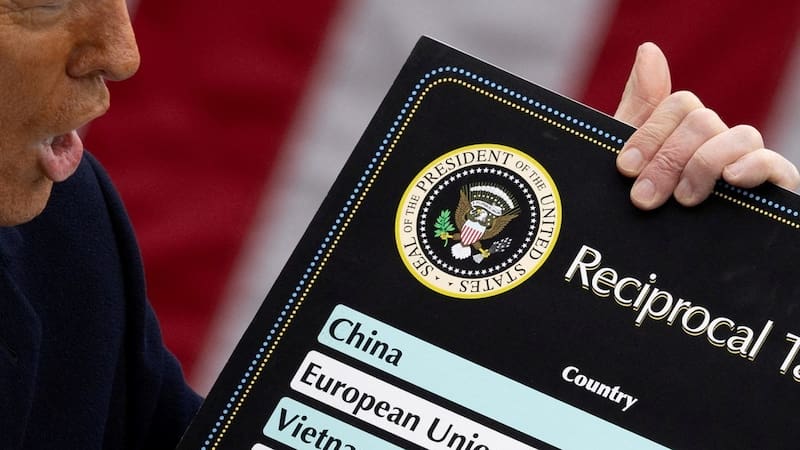
In addition, the trade deal signed with Washington, which CEPA says imposes 15 areas of commitment on Argentina and only two, and conditional ones, on the United States, could come under greater scrutiny from a Congress more attentive to U.S. producers.
Backers of Milei and the 2027 “gap”
The impact on the country runs along two tracks: financial, through rates, and political, because Trump is Javier Milei’s main ally. His administration intervened before the October 2025 midterm elections with a $20 billion swap line and direct intervention by the U.S. Treasury in the foreign exchange market. Both Scott Bessent and Luis Caputo say that support could be repeated in 2027.
Democrats, however, introduced the “No Argentina Bailout Act” in both chambers to suspend the swap, and the “American Farmers First Act” to compensate U.S. producers hurt by Argentine competition. With a Democratic majority, these bills would not by themselves prevent new assistance, but they would make it harder and raise its political cost.
That is where the troubling number comes in. According to CEPA estimates, without Bonares issuance, the Treasury could need to buy about $12.5 billion from the central bank in 2027. On top of that are net payments to international organizations of $4 billion, of which $2.7 billion corresponds to the IMF. So far, tensions with the institutions have been resolved because they gave in to Trump’s pressure to keep financing Milei, and an opposition-controlled Congress with a weakened White House could change those priorities.
The paradox, CEPA concludes, is that a Democratic victory could improve global financial conditions, but weaken the political backing on which the economic program depends to make it through 2027. And since Trump cannot run for another term and could become a lame duck, the report does not rule out the possibility that he will radicalize his agenda knowing he has only two years left in power.