

Por Sofía Renó
En esta noticia
Ross Elder, commander of NASA’s simulated mission, said that “The goal of putting humans on Mars is not only achievable, but rather inevitable” after completing 378 days of confinement with three other crew members in a habitat designed to recreate the conditions of the Red Planet.

The second CHAPEA mission (Crew Health and Performance Exploration Analog) ended Saturday at NASA’s Johnson Space Center in Houston, Texas, where the four participants had been isolated for more than a year, the EFE news agency reported.
Ross Elder said that while traveling to Mars involves enormous risks, sending humans to the planet is possible if it combines “the pursuit of knowledge, strong vision and leadership, creativity, resilience, hard work, and an extraordinary foundation,” he said at a news conference.
What CHAPEA 2 was like, the mission that simulated a year of life on Mars
CHAPEA 2 brought together Ross Elder, Ellen Ellis, Matthew Montgomery, and James Spicer, who lived for 378 days in a 160-square-meter habitat built with 3D printing to reproduce the challenges of a future expedition to the Red Planet.
The project is part of NASA’s research program to study how crews respond to prolonged isolation, confinement, and limited resources before setting out on long-duration space missions.
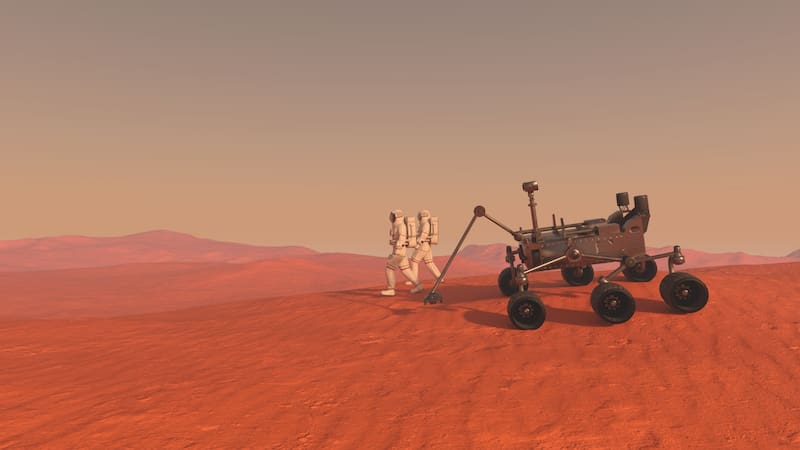
What challenges did the crew face during the 378-day isolation?
According to Sarah Whiting, the CHAPEA project scientist, the four participants tested operations independent of Earth, without receiving real-time guidance from mission control. They also carried out an intense, physically demanding schedule with limited resources.
Whiting highlighted another distinguishing feature of the experiment: “There was no crew rotation as is normally done on the International Space Station. These conditions are very demanding for carrying out a mission.”
The data collected will allow researchers to better understand how human teams adapt to extreme isolation, one of the main obstacles to future trips to Mars.

NASA identifies ground support as a key piece in reaching Mars
CHAPEA 2 flight surgeon Ellen Ellis stressed that a future crew traveling to the Red Planet will need “a very tightly integrated ground support team,” since that will make “their work easier” thanks to the “constant collaboration of the exercise, behavioral health, nutrition, and medical monitoring teams.”
Ellis also warned that “we have a narrowing window of opportunity to maintain U.S. preeminence in space,” a “strategic position that will only be preserved through deliberate action.”
As an example, she mentioned NASA’s lunar base and the National Space Academy, initiatives that, she said, “create opportunities.” She also urged people to “take the initiative, lead with science that benefits the economy, and ensure” the nation’s space legacy “for our children’s children.”