
En esta noticia
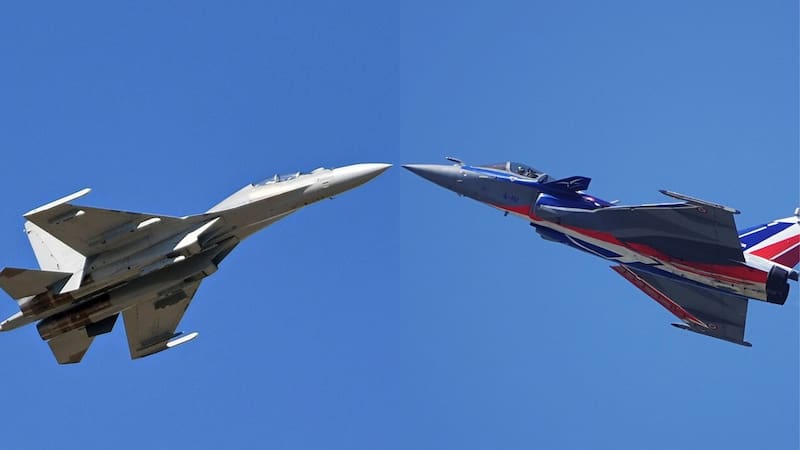
An unusual aerial encounter took place over Egypt when Chinese J-16 fighter jets conducted combat training against French Dassault Rafale fighters belonging to the Egyptian Air Force during a joint military exercise. The event marked the first documented instance of both types of aircraft participating in air combat training together.
The encounter occurred on August 23 as part of Eagles of Civilization 2026, a joint exercise between China and Egypt. Rather than being an actual confrontation, the activity consisted of simulated combat designed to allow pilots from both countries to train against different aircraft and tactics.
J-16 and Rafale faced each other in simulated combat
The Chinese Shenyang J-16 is a twin-engine, two-seat fighter classified as a 4.5-generation aircraft. It is designed for long-range missions and combines advanced avionics, radar and electronic warfare capabilities.
On the other side were Egyptian Rafales, the French-built multirole fighters that form an important part of Egypt’s modern combat-aircraft fleet.
During the first day of flight operations, pilots conducted one-on-one aerial combat exercises. Before the aircraft took off, the crews received technical briefings covering safety procedures and management of the airspace.
The aircraft subsequently performed maneuvers under simulated combat conditions. Chinese state media released footage showing an Egyptian Rafale flying close to a J-16, providing an unusual view of the two aircraft operating against one another.
Did the Chinese fighter beat the Rafale?
Despite the attention surrounding the encounter, there is no confirmed winner.
Neither China nor Egypt has announced an official score from the simulated engagements. The available footage shows the aircraft maneuvering against each other, but it does not establish that either fighter achieved a definitive victory.
That distinction is important because a training exercise cannot automatically be interpreted as proof that one aircraft is superior to the other. The outcome of a simulated engagement can depend on factors such as the scenario, rules of engagement, weapons restrictions, pilot tactics, starting position and support from other aircraft.
Therefore, claims circulating online about a decisive victory for the J-16 or the Rafale should be treated cautiously unless they are supported by official information.
China brought an entire support package to Egypt
The J-16 deployment was notable for another reason. It was the aircraft’s first deployment to Africa, according to the available reporting.
China did not send only fighter jets. Its contingent included support aircraft such as the KJ-500 airborne early-warning aircraft, YY-20A aerial tankers, Y-20 transport aircraft and a Y-9LG electronic-jamming platform. Z-20 helicopters were also part of the deployment.
That combination allowed Chinese forces to practice not only fighter-versus-fighter maneuvers but also operations involving the broader network of aircraft that supports modern air combat.

Why the exercise is attracting so much attention
The encounter is significant because the Rafale is one of the most capable Western-designed fighters currently operated by a number of countries, while the J-16 represents one of China’s principal advanced combat aircraft.
The exercise therefore offered pilots from both sides an opportunity to observe how their aircraft and tactics perform against a different design.
It also has a broader geopolitical dimension. Egypt has traditionally maintained close military relations with the United States and operates American-made aircraft, including F-16s. At the same time, Cairo has expanded its defense relationships with other countries, including China.
For Beijing, meanwhile, exercises such as this provide an opportunity to operate advanced aircraft far from Chinese territory and gain experience in unfamiliar environments.
The J-16 has already trained against Western fighters
The Egyptian exercise was not the first time the J-16 has encountered a Western-designed fighter during an international drill.
Earlier in 2026, Chinese J-16s also participated in training involving Sweden’s JAS 39 Gripen, operated by Thailand, during the Falcon Strike exercise. The new Egyptian exercise therefore represents another opportunity for Chinese pilots to practice against a different Western fighter design.
The comparison is particularly interesting because the J-16 and Rafale approach combat from somewhat different design philosophies. The Chinese aircraft is larger and heavier, with two engines and two crew members, while the Rafale is a smaller multirole fighter designed for both land-based and carrier operations.