
En esta noticia
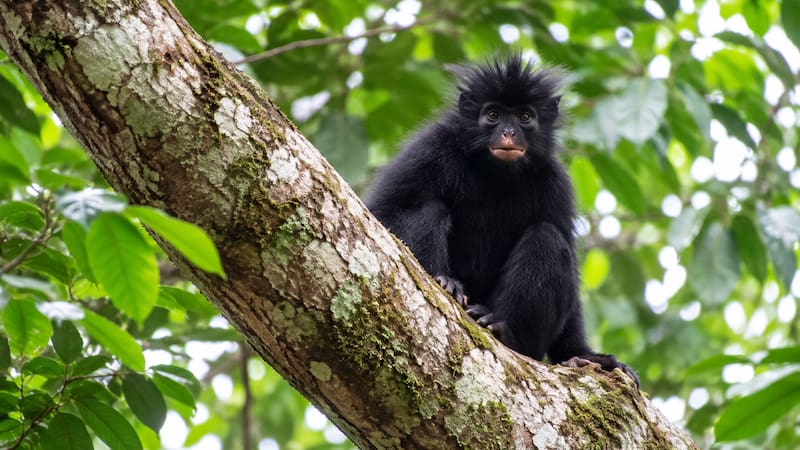
For 10 years, an international team of researchers closely tracked a monkey living in the Democratic Republic of Congo to determine whether it was an unknown primate species or not.
On July 15 of this year, in the journal PLOS One, the animal was officially described as a new species of monkey, scientifically named Colobus congoensis, though local communities nicknamed it Likweli.
“Discovering a primate species is exceptionally rare, especially in populations previously unknown to science,” says Julia Arenson, a co-author of the study and a postdoctoral researcher in Yale’s Department of Anthropology.

Why experts had to investigate for 10 years to confirm it was a new monkey species
This primate lives in the treetops of the tropical forest in Lomami National Park, which made it difficult for researchers to gather enough evidence to prove it was a completely new species.
The monkey was observed 114 times between 2018 and 2022, and during the years of research it was photographed so its features could be compared with those of other primates, its DNA was studied, and the sounds it makes were compared.
In addition, anatomical analyses were carried out using three deceased specimens that were in hunters’ possession and were confiscated in 2021 with official authorization.

Why experts say it is an “extremely rare” monkey
According to information shared by Yale University, this monkey belongs to the colobus group and has black fur, a smaller size than its similar species, orange and cream-colored markings around its mouth and nose, a long tail and white areas under its tail.
Although its similarity to Colubis satanas - another black-furred colobus monkey species - confused experts, analyses determined that the ancestors of both species split between 4.7 and 5.8 million years ago, meaning they evolved separately.
Its rarity lies in the fact that, although local communities usually know the species around them, in interviews with 52 villages, only eight could identify it, reinforcing the idea that it is a species that is hard to tell apart.

Experts warn the monkey should be classified as “endangered”
Because its range is limited and, according to specialists, the Likweli population is small, hunting is a direct threat to the survival of this new species.
For this reason, researchers recommended classifying the primate as “endangered”.
“Our analyses provide strong evidence that this is a new and distinct species, endangered,” says Eric Sargis, Yale professor of anthropology and co-author of the paper, who stresses the importance of protecting the biodiversity of the park where this monkey lives, which until now had been a scientific mystery.