En esta noticia
For millions of years, a gigantic predator known as Deinosuchus schwimmeri dominated the ecosystems of the eastern United States. This enormous relative of modern alligators lived between 83 and 76 million years ago and today can be remembered as a “terror crocodile” for its ability to hunt dinosaurs.
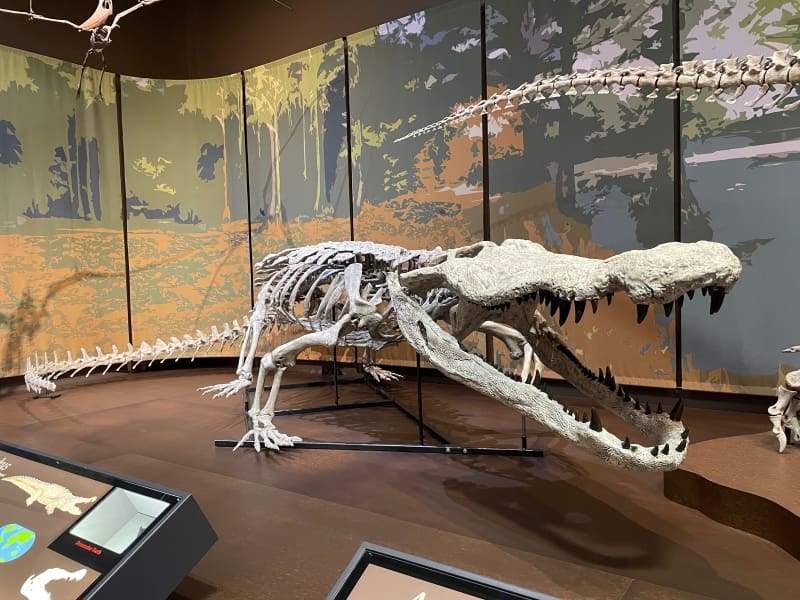
Recently, a group of researchers managed to “revive” it by creating the first mounted, scientifically accurate replica of its skeleton.
The project included the participation of geologist and paleontologist David Schwimmer, a professor at Columbus State University and one of the leading experts on this predator.
What the “terror crocodile” that devoured dinosaurs in the eastern United States was like
According to information released by Columbus State University, the reptile that inhabited the eastern United States during the Cretaceous Period.
- It reached up to 9.45 meters in length
- It was the size of a school bus
- It is now considered one of the dominant predators of its time.
Experts say it was the top hunter in its ecosystems, which allowed it to dominate the food chain for years.
Why scientists managed to “revive” it
The replica was commissioned by the Tellus Science Museum, located in Cartersville, Georgia. Its fabrication took two years of collaboration between Schwimmer and Triebold Paleontology Inc, a company specializing in fossil models for museums and universities.
To recreate this terror crocodile, experts analyzed 3D scans of the available fossil records and reconstructed its skeletal structure and dermal armor.
Specialists explain that these reconstructions are not only meant to create visual impact but also to provide information to gain a deeper understanding of the great prehistoric predators.
A study that took more than 40 years
The story of this reconstruction began more than 40 years ago. Since 1979, the expert devoted himself to searching for and excavating fossils of this predator in states such as Alabama, Georgia, and Texas.
His study was so thorough that in 2020 a group of paleontologists officially classified this animal as a new species and decided to name it Deinosuchus schwimmeri in his honor.
Today the replica is on display in the museum, bringing the public and the scientific community closer to one of the most impressive predators in the history of the United States.