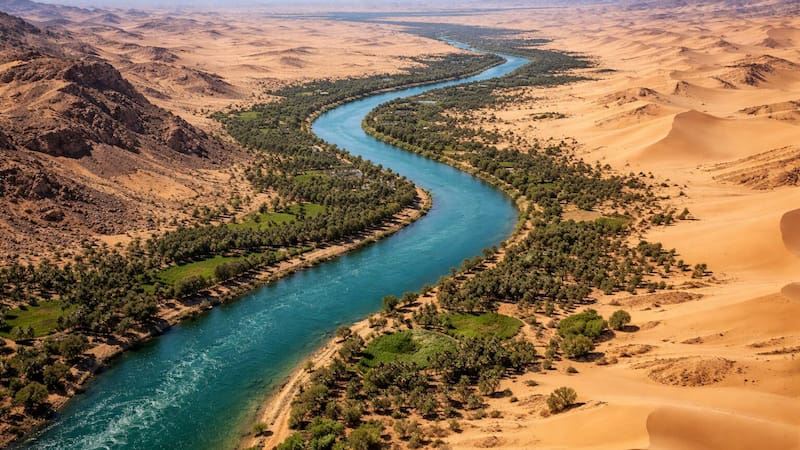

Following that logic, one of the world’s most integrated water transportation networks and management systems was built, a system that connects the humid north with the arid regions of the south and today depends both on natural sources and on desalinated Mediterranean water.
What at first glance appears to be a blue strip crossing fields and dry areas is, in reality, a technical network that combines open channels, pressurized pipes, underground tunnels, pumping stations, and strategically distributed reservoirs.
Israel did not create a river in the desert. It created something more complex: a national water infrastructure capable of moving water across a territory marked by scarcity, irregular rainfall, and climate pressure.

More than a river: the architecture of water
One of the most recognizable segments is the Beit Netofa Valley Canal, approximately 17 kilometers long. Its oval shape corresponds to the geological characteristics of the terrain. From an aerial perspective, that canal creates the illusion of a continuous stream running through arid and agricultural areas.
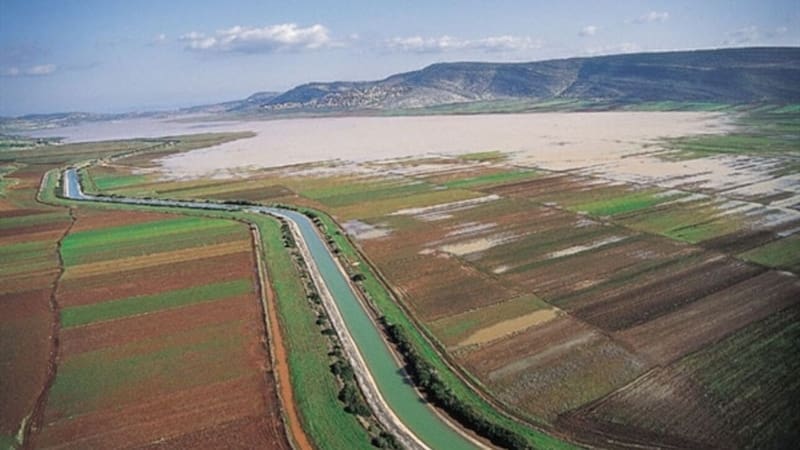
The heart of the system is the so-called National Water Carrier of Israel, a structure with nearly 130 kilometers along its main axis, designed to transport large volumes of water from the north of the country to regions with water deficits, including areas near the Negev Desert.
Although it is commonly called an “artificial river,” the aqueduct is not a dug natural channel, but rather a water-transfer infrastructure. Some sections are open to the air, others are buried, and several operate under pressure, depending on the geography and type of soil present.
The strategic reasons that led Israel to deploy a network of this kind
The project began in the 1950s, conceived as a structural solution to three fundamental problems:
Desalination redefines water supply
Since the beginning of the new millennium, the system underwent a significant change with the spread of desalination plants on the Mediterranean coast. These facilities, based on reverse osmosis technology, began producing drinking water on an industrial scale.
The implementation of five large-scale plants allowed desalinated Mediterranean water to meet an increasingly large share of urban consumption. In certain years, more than 60% of the water used in Israel was obtained from the sea.
The desalination process is not instantaneous: the water goes through stages of filtration, salt removal, pressure control, and then a remineralization stage to meet drinking-water standards before being added to the reservoirs and existing networks.
When water flows against the current
In 2025, Israel began pumping desalinated water into the Sea of Galilee with the aim of restoring its level, which had dropped significantly due to prolonged periods of drought.
This change indicates that desalination has evolved from being merely a complement to becoming an essential element in maintaining the country’s water balance.
In recent years, the system has even begun to operate contrary to its original logic.