
Por Germán Takaichi
En esta noticia
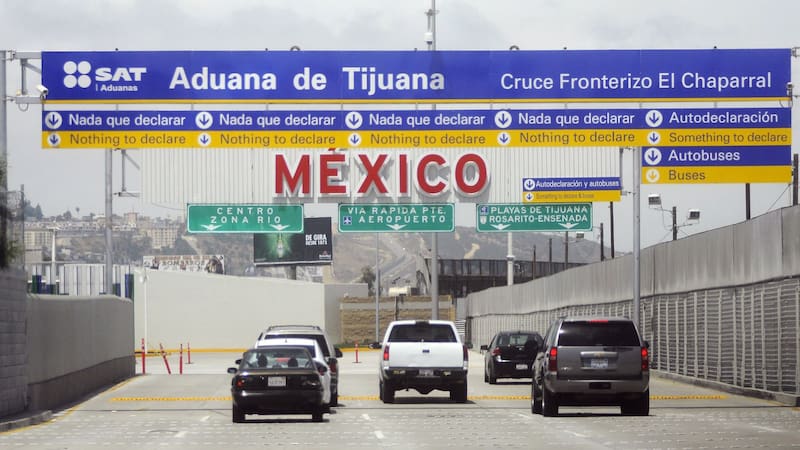
Mexico is pushing eight new border crossing projects with the United States to expand international infrastructure, strengthen trade, and cut transit times for goods.

The announcement was made by Foreign Minister Roberto Velasco during his appearance before the Senate on October 14, where he explained that nearly 85% of bilateral trade currently moves through 56 bridges and crossings.
The plan includes new connections at different points along the border, along with technology to speed inspections and changes to operating hours at existing crossings.
What are the eight new border crossings Mexico is proposing with the United States?
According to information published by the agency EFE on October 14, the eight projects mentioned by the foreign minister are:
- Mesa de Otay II-Otay Mesa East: will connect Tijuana, Baja California, with San Diego, California.
- Agua Prieta II-Douglas II: will connect Sonora and Arizona.
- Anapra-Sunland Park: will link the Anapra area in Chihuahua with New Mexico.
- Acuña-Del Río II: refers to the connection between Ciudad Acuña, Coahuila, and Del Rio, Texas.
- Puerto Verde: international crossing project in the Coahuila-Texas region.
- Green Corridors: includes an elevated freight crossing between Nuevo León and Texas.
- Nuevo Laredo IV-Laredo V: proposes a new connection between Tamaulipas and Texas.
- Flor de Mayo: would connect Matamoros, Tamaulipas, with Brownsville, Texas.
Why does Mexico want more border crossings, and what would they be used for?
The main goal is to speed the movement of goods between the two countries. As the foreign minister explained, about 85% of bilateral trade moves through 56 bridges and border crossings, so expanding capacity would cut wait times and improve the logistics of trade.
The strategy also calls for extending operating hours, implementing joint cargo inspections, and adding technology that would allow vehicles to be checked without having to open them.
Another goal is to divert heavy freight traffic away from border cities to reduce truck traffic in urban areas.
What existing border projects will also be modernized?
In addition to pushing eight new crossings, Mexico also plans to upgrade infrastructure already in use. EFE reported that among the projects is the expansion of the Reynosa-Pharr international bridge, between Tamaulipas and Texas, whose binational inauguration was scheduled for November 2026.
The modernization is part of a strategy to increase cargo capacity and improve connectivity between the two countries.
As Mexico pushes new border crossings, a dispute emerged in Texas
After the trade project announcement, a territorial dispute emerged. Specifically, on October 29, Texas authorities announced that they recognized nine islands in the Rio Grande as state property, with a combined area of about 66 acres, and would allow law enforcement access to patrol those lands.
The decision prompted a response from Mexico’s Foreign Affairs Ministry (SRE): On October 31, the foreign ministry said no state government can unilaterally change international borders.
The agency noted that the 1970 Border Treaty establishes that the border on the Rio Grande follows the center of its normal channel and that the International Boundary and Water Commission (CILA) is the body authorized to determine which country each island belongs to.