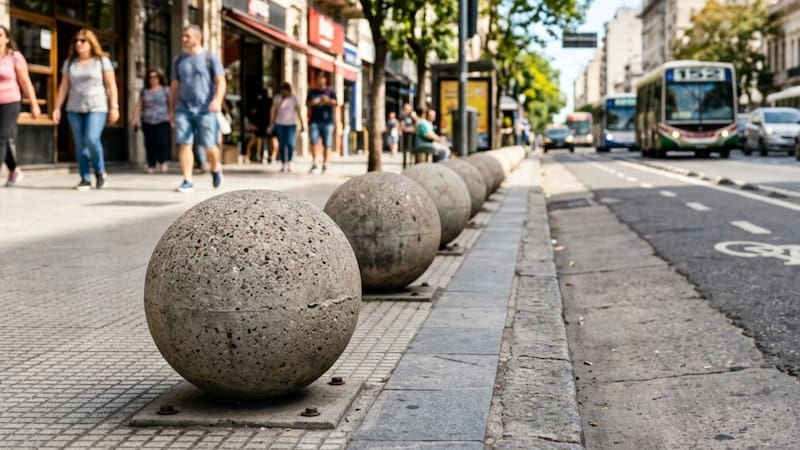

When we are walking, it is very common to see round cement structures placed on sidewalks. What are they and what are they for?
The concrete spheres — also called balls, bollards or boundary markers — that are installed at the edge of the sidewalk, generally on the property line or at corners, near curbs, ramps and pedestrian access points. Their presence is common in Buenos Aires neighborhoods with high traffic density and in areas where cars, motorcycles and pedestrians coexist in a small space.

What are the cement balls for
They have five main functions:
- Prevent parking on the sidewalk. This is their main function: to keep cars or motorcycles from invading the pedestrian space, something especially common on narrow blocks or in front of businesses.
- Protect pedestrians. They act as a physical barrier that separates the roadway from the sidewalk, reducing the risk of a vehicle accidentally going up onto the space where people walk.
- Protect underground infrastructure. In many cases, they mark areas where there are pipes, wiring, or urban tree roots that could be damaged by the passage of heavy vehicles.
- Mark property or public-use boundaries. They are also used to signal the boundary between public space and private access points, such as garages or building entrances.
- Preserve accessibility ramps. In front of wheelchair ramps, they serve an additional role: preventing them from being blocked by poorly parked cars, thus ensuring passage for people with reduced mobility.
Why are they made of cement and not another material
Concrete was chosen because of a combination of low cost, durability, and impact resistance. Unlike metal or plastic bollards, the cement balls do not require frequent maintenance and withstand vehicle impacts without deforming, which makes them the preferred option for municipalities with tight budgets for urban furniture works.