
En esta noticia
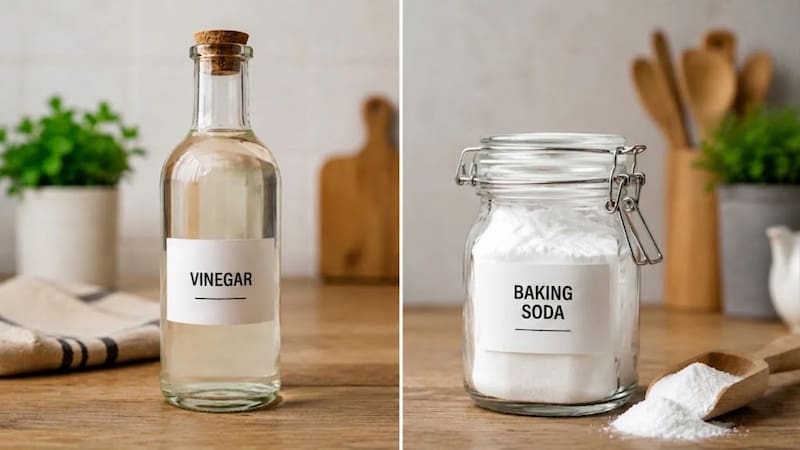
When it comes to cleaning the house, there are two inexpensive products that often appear among the most commonly used alternatives: baking soda and vinegar. Although both can help remove dirt, stains, and bad odors, they do not work in the same way and are not suitable for the same surfaces.
The difference lies mainly in their chemical properties. Baking soda acts as a mild abrasive, while vinegar has an acidic composition that is especially useful against certain mineral residues. That is why choosing one or the other depends on the type of dirt to be removed.

What is the difference between baking soda and vinegar
Baking soda can help loosen traces of dirt and, in addition, has the ability to absorb odors. Because of its characteristics, it can be used in different areas of the home, always taking into account the surface material.
Vinegar, on the other hand, stands out for its acidity. This property can be more effective for removing soap residue, hard water buildup, and mineral deposits that can appear on faucets, shower enclosures, and other damp areas.
Therefore, there is not necessarily an absolute winner between the two products: each may be more suitable depending on the cleaning task.
When is it convenient to use baking soda
Baking soda is especially practical when the goal is to absorb odors or remove dirt and grease.
Among the household uses mentioned by experts are:
- Refrigerator: can help absorb bad odors.
- Trash bins: helps reduce unpleasant odors.
- Carpets and mattresses: it can be sprinkled on the surface, left to act for 10 to 15 minutes, and then vacuumed.
- Clothes: a small amount can be added to the wash to help with odors.
- Pots and pans: can help loosen food and grease residue.
- Oven: useful for working on certain food residues and dirt.
To clean stuck-on residue, one option is to mix the baking soda with a little water until a cleaning paste forms.
However, it is not recommended to use it indiscriminately on all surfaces. The source consulted advises avoiding its use on marble and silver, due to the characteristics of these materials.
When is it better to use vinegar
White vinegar can be a particularly useful alternative when stains caused by minerals or soap residue appear.
Its acidity can help treat:
- Faucets with white deposits caused by hard water.
- Shower enclosures with residue buildup.
- Sinks and bathtubs.
- Glass and windows.
- Certain ceramic, vinyl, and linoleum surfaces.
For glass and windows, a mixture of equal parts water and vinegar can be used as a cleaning solution. Vinegar can also be added to the wash to help soften garments and reduce certain odors.
What cleans better: baking soda or vinegar?
Experts say it depends on the type of dirt. If it is odors, grease, or food residue, baking soda may be the more convenient option. Its mild abrasive action also helps loosen dirt without resorting to harsher products.
In contrast, when the problem is mineral deposits, hard water marks, or soap residue, vinegar can provide better results thanks to its acidity.
Therefore, rather than choosing a single product as the best cleaner, experts recommend knowing what each one is for and using them according to the task.
Can baking soda and vinegar be mixed?
Although the combination is very popular in homemade cleaning tricks, mixing baking soda and vinegar does not produce a more powerful cleaner. When they come into contact, both react, and their properties are partially neutralized.
The reaction can be useful in certain situations, such as when trying to unclog a drain, but that does not mean the mixture is superior for routine cleaning tasks.
In addition, there is a particularly important precaution: vinegar should never be mixed with bleach. The combination can generate toxic chlorine gas, which is dangerous if inhaled.