
En esta noticia
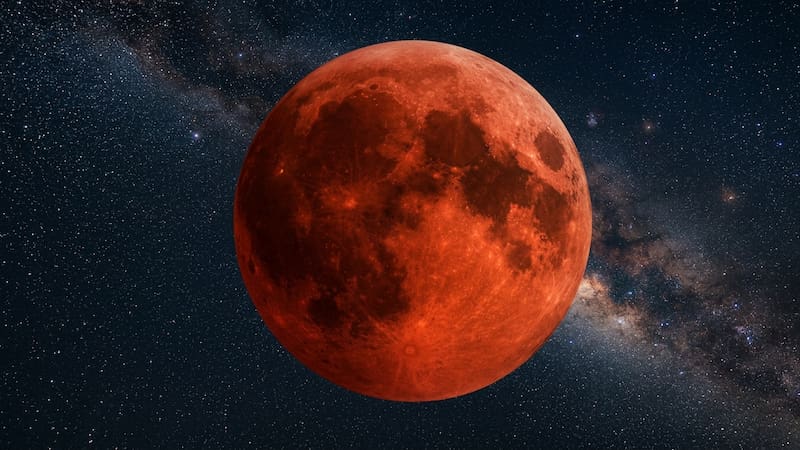
Skywatchers across the Americas are preparing for a spectacular celestial event on the night of Thursday, August 27, and into Friday, August 28. A deep partial lunar eclipse will cause about 96% of the Moon to enter Earth’s darkest shadow, creating an almost total eclipse and potentially giving the Moon a striking reddish or copper-colored appearance.
Although the event will not technically be a total lunar eclipse, its appearance could be remarkably similar. At the peak, only a small portion of the Moon will remain outside Earth’s umbra, while most of the lunar surface will be immersed in the planet’s shadow.

When will the lunar eclipse happen?
The eclipse will unfold over several hours between August 27 and August 28, depending on the observer’s location. According to NASA, the deepest point will occur at approximately 4:13 a.m. UTC on August 28, when 96.3% of the Moon’s disk will be inside Earth’s umbra.
For viewers in the United States, the timing will depend on the time zone. On the East Coast, the most dramatic phase will occur around midnight, while observers farther west will see the eclipse reach its peak earlier in the evening.
The entire eclipse will last more than five hours, although the most visually impressive portion will be considerably shorter.
Where will the eclipse be visible?
The Americas will be in the best position to see the event. Much of North America, Central America and South America will be able to observe the eclipse, with conditions varying depending on local weather and the Moon’s position in the sky.
In the United States, the eclipse will be visible across most of the country, although Alaska and northwestern Canada will miss the main event. The western United States will see the Moon already undergoing the eclipse as it rises, while areas farther east will have an opportunity to watch much of the phenomenon during the night.
Parts of Europe and western Africa will also be able to see portions of the eclipse, although the timing will limit how much of the event is visible in those regions.
More than 3 billion people worldwide could see at least part of the eclipse if weather conditions cooperate, while the Americas offer the best opportunity to watch the complete sequence.
Why will the Moon turn red?
The reddish color is produced by Earth’s atmosphere.
During a lunar eclipse, Earth moves between the Sun and the Moon and blocks direct sunlight from reaching the lunar surface. However, some sunlight passes through Earth’s atmosphere before reaching the Moon.
The atmosphere scatters shorter blue wavelengths more strongly, allowing more red and orange light to continue through. That light is then projected onto the Moon, giving it a copper, orange or reddish appearance.
Because this eclipse is partial rather than total, the entire Moon will not turn red. Instead, most of the lunar disk can develop the characteristic reddish hue while a thin portion remains illuminated.
Is this a total lunar eclipse?
No. Astronomically, this is a deep partial lunar eclipse.
The distinction is important because the Moon will not be completely covered by Earth’s umbra. At maximum eclipse, approximately 96.3% of the lunar disk will be inside the umbra, leaving a small section outside the darkest portion of the shadow.
Nevertheless, the event is expected to look almost like a total eclipse because such a large portion of the Moon will be immersed in the shadow.
It is also being described as a near-total or “blood moon”-like eclipse because of the reddish-orange color that can develop during the deepest phase.
Can you watch it without special equipment?
Yes. Unlike a solar eclipse, a lunar eclipse can be viewed safely with the naked eye. No special protective glasses are required.
For the best experience, astronomers recommend finding a location with a clear view of the sky and minimal light pollution. Binoculars or a telescope can also reveal more detail on the lunar surface as Earth’s shadow moves across it.
Weather will ultimately determine how clearly the eclipse can be seen. Even in areas with perfect astronomical conditions, clouds could obscure the Moon.
A rare opportunity for skywatchers
The August eclipse is particularly noteworthy because it will be the deepest partial lunar eclipse visible from the Americas in several years.
The next total lunar eclipse visible from much of the Western Hemisphere will not occur until 2029, making this week’s event an especially good opportunity for anyone interested in observing the night sky.