

En esta noticia
An unprecedented deposit, with reserves exceeding 1,000 tons of gold, was identified in China’s central province of Hunan, according to confirmation from the local Geological Bureau.
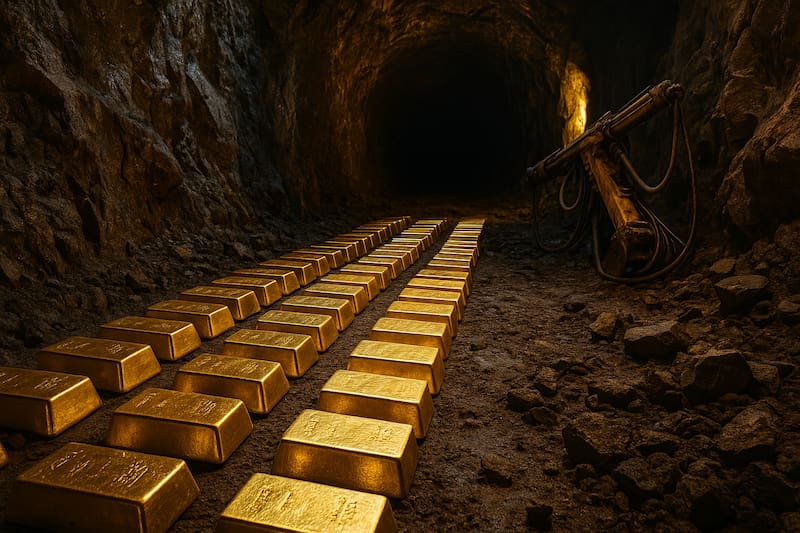
The discovery took place in the Wangu gold field, in Pingjiang County, at depths ranging between 2,000 and 3,000 meters. More than 40 gold veins were found there, forming one of the most significant deposits discovered in recent history, and whose ownership belongs entirely to China.
The exceptional discovery: the process of locating the gold ingots
Preliminary analyses indicate that at a depth of 2,000 meters, 300 tons of gold have been identified, while the estimated total exceeds 1,000 tons, with an approximate value of 600 billion yuan (equivalent to 83 billion dollars or 79 billion euros).
Likewise, some drilled rock samples show visible gold, with concentrations reaching 138 grams per ton of ore.
Chen Rulin, a mining prospecting expert, highlighted the high quality of the metal and its strategic importance for the industry, according to what was reported by the state agency Xinhua.
How was the gold deposit discovered?
According to the official statement, the treasure was identified using advanced prospecting technologies, including 3D geological modeling, which made it possible to precisely detect the location of the gold veins. Liu Yongjun, deputy director of the Hunan Geological Bureau, noted that signs of gold were also recorded in areas near the main site, which opens the possibility of new discoveries in the region.
Considered one of the largest deposits found in China in recent years, this deposit strengthens national reserves and could bolster the country’s ability to secure the supply of a key resource. In line with this trend, in March 2023, another major deposit of nearly 50 tons of gold was identified in the eastern province of Shandong.

China produced 375.16 metric tons of gold in 2023, 3.12 more than the previous year, representing a year-on-year increase of 0.84%, according to data from the country’s Gold Association. At the same time, domestic gold consumption grew by 8.78% to reach 1,089.69 tons.
In recent years, the expansion of China’s middle class and the growing preference for buying bullion as a safeguard against global volatility have notably driven domestic demand for this precious metal.