
En esta noticia
An independent researcher claims to have identified the name of Moses in two inscriptions carved 3,800 years ago on the walls of a turquoise mine in the Sinai Peninsula, Egypt.
The discovery, the result of eight years of analysis using high-resolution photographs and 3D scans, reopened one of archaeology’s oldest debates: did the biblical leader of the Exodus really exist?
Michael S. Bar-Ron studied the Proto-Sinaitic inscriptions from the Serabit el-Khadim site using material from the Harvard Semitic Museum.

According to his interpretation, two of those inscriptions read “zot mi’Moshe” —“this is from Moses,” in Hebrew— and “ne’um Moshe”, which translates as “a saying of Moses.” If confirmed, they would be the first extra-biblical references to the figure in written records.
What did the researcher find in the 3,800-year-old inscriptions?
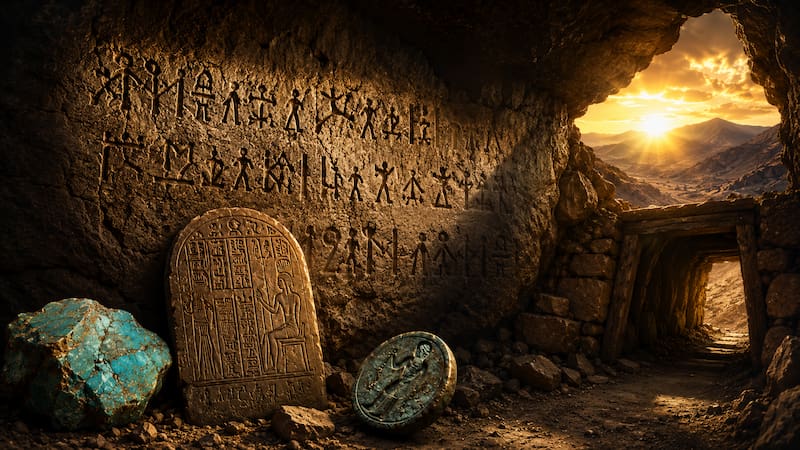
The inscriptions are part of a set of more than two dozen Proto-Sinaitic texts originally found by archaeologist Sir William Flinders Petrie in the early 20th century. They were likely produced by Semitic workers during the reign of Pharaoh Amenemhat III, around 1800 BC, and are considered some of the oldest known alphabetic texts, even older than Phoenician.
Beyond the mentions of Moses, nearby inscriptions contain invocations to “El” —the archaic Hebrew deity— and references to Baʿalat, the Semitic counterpart of the Egyptian goddess Hathor. Some dedicated to Baʿalat appear to have been scraped away, which Bar-Ron interprets as evidence of a theological dispute. A burned temple at the site and references to “slavery” and a call to depart would, according to the researcher, reinforce the biblical account of the Exodus.
What is known about the site:
- The inscriptions date from the reign of Amenemhat III (~1800 BC)
- The site also houses the Reniseneb Stele and the seal of an Egyptian official of Asian origin
- The Proto-Sinaitic texts are notoriously difficult to decipher

Why did the discovery split the experts?
Bar-Ron acknowledges that his research has not yet been peer-reviewed and is still ongoing. His academic advisor, Dr. Pieter van der Veen, supports the work. However, Dr. Thomas Schneider, an Egyptologist at the University of British Columbia, called the claims “completely unproven and misleading” and warned that “arbitrary identification of letters can distort ancient history”.
The skepticism has a methodological basis: Proto-Sinaitic writing is one of the most difficult writing systems to decipher, and specialists warn that subjective interpretations can lead to erroneous conclusions. Bar-Ron is confident that future research will test — or refute — his conclusions. For now, the debate is open.