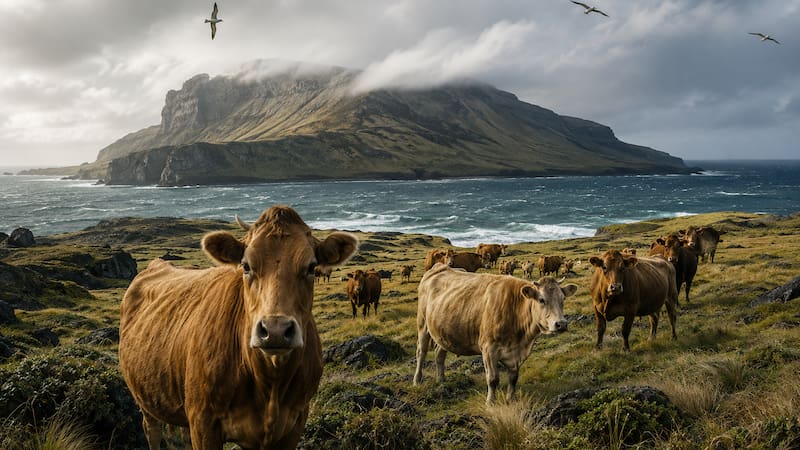

A farmer named Heurtin abandoned five cows on Amsterdam Island in 1871, a small 54-square-kilometer French territory lost in the southern Indian Ocean.
That initial founding group of five animals became a herd of thousands that survived for more than a century in extreme conditions. In 2024, geneticists analyzed their DNA —preserved decades before their extinction— and the results dismantled a theory that science had taken for granted.
The team worked with samples taken from animals in 1992 and 2006, before the last specimen was removed in 2010 as part of an ecological restoration program.

The study was published in July 2024 in the specialized journal Molecular Biology and Evolution, led by geneticist Mathieu Gautier with researchers from INRAE and the University of Liège in Belgium.
What the scientists discovered
The cattle genome showed two clearly differentiated descent lines.
While most of it —about three quarters— came from European taurine breeds related to the modern Jersey, historically adapted to cold, wet, and windy climates, the remaining quarter corresponded to Indian Ocean zebu cattle, linked to cattle from Madagascar and Mayotte.
That combination, already present before reaching the island, would explain why five animals were able to thrive in such a hostile environment.
The study’s central finding refutes a 2017 study published in Scientific Reports, which held that the herd had undergone accelerated island dwarfism: a reduction of up to three quarters of its original size in just over a century.
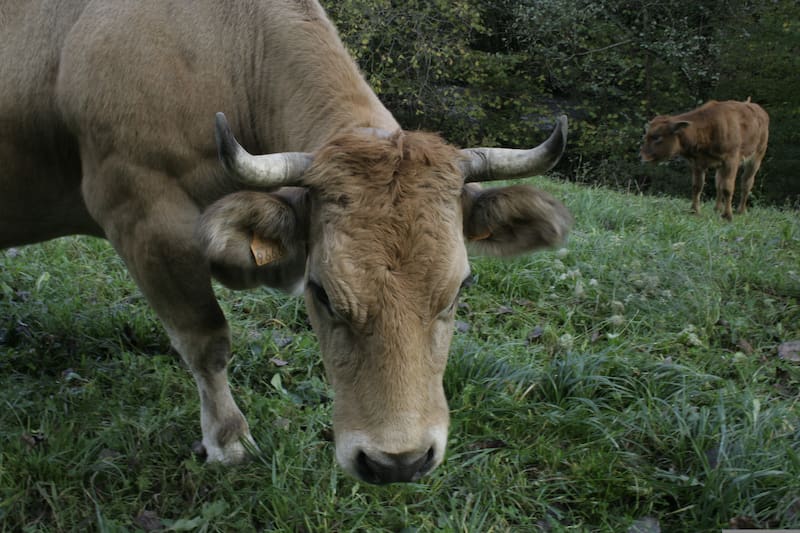
The genetic analysis found no sign of selection for smaller size. The data indicate that the founders were already small when they arrived, and that their dual lineage gave them from the start the biological tools to adapt to the hurricane-force winds, cold, and freshwater scarcity of Amsterdam Island.
How they survived 130 years on a remote island
With so few founders, inbreeding was inevitable for generations. The researchers estimated inbreeding levels close to 30%, a threshold that in most animal populations triggers hereditary diseases and can lead to extinction.
Despite this, the herd did not collapse: no signs were detected of an accumulation of harmful genetic variants or population decline.
What prevented collapse was the speed of growth. The herd expanded quickly enough to maintain genetic diversity before inbreeding could erode it.
This analysis was possible because researchers preserved biological samples in the decades before eradication —without there being a formal preservation program at the time the last animals were removed in 2010—, which made it possible decades later to reconstruct the complete genetic history of a herd that began with five cows on a remote island.

Why the herd was eliminated
- The cattle threatened endemic species such as the Amsterdam albatross and the tree Phylica arborea
- In 1987, a fence was installed and more than a thousand animals were removed from the southern sector
- The last specimen was removed in 2010 as part of an ecological restoration plan
- In 2019, UNESCO declared the French Southern Lands a World Heritage Site