
Por Magalí Schefer
En esta noticia
The United States will need more electricians over the next decade to keep pace with construction growth, modernize its power grid and meet rising energy demand.
The Bureau of Labor Statistics (BLS) projects that employment in this occupation will grow 9% from 2025 to 2035, a faster pace than the average for jobs nationwide.
The agency estimates there will be 72,700 annual openings for electricians during that period. Demand will be driven by both the replacement of workers who retire or change occupations and the creation of new jobs.


How much an electrician makes in the United States
The average annual salary for an electrician in the United States reached $63,190 in May 2025, according to the BLS. That equals about $30.38 an hour.
Pay is higher than in other fields: construction workers earned $58,150 a year, while the average across all occupations was $50,980.
However, earnings vary depending on experience, employer and industry:
- The lowest-paid 10% earned less than $42,640 a year.
- The median wage was $63,190.
- The highest-paid 10% earned more than $108,510 a year.
In manufacturing, the median wage was $74,550, while those working for electrical contractors earned about $61,570 a year.
Why the United States needs more electricians every year
Construction growth and the development of new technologies are increasing the need for electrical installations in homes, businesses, factories and data centers.
The BLS says these workers will be critical to connecting new energy sources, such as solar and wind, to homes, businesses and the power grid.
The growth of artificial intelligence is also a factor. Data centers that support this technology require large amounts of electricity, driving upgrades to the national grid and the construction of energy infrastructure.

How to become an electrician
To enter the profession, the usual educational requirement is a high school diploma or equivalent. A college degree is not required.
Most learn through hands-on training programs known as apprenticeships, which combine technical classes with supervised on-the-job experience. Another option is to attend a technical school.
What electricians do and why they matter for construction
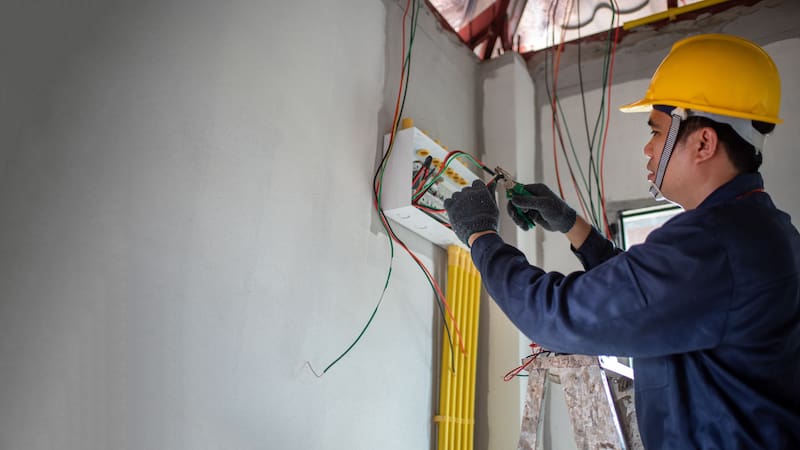
Electricians install, maintain and repair power, lighting, communications and control systems.
Their work is essential for buildings to operate. On new construction projects, wiring is usually easier to reach. By contrast, maintenance work may require finding faults in tight spaces or repairing equipment that is hard to access.
Their main tasks include:
- Reading blueprints and technical diagrams.
- Installing wiring, lighting and control systems.
- Inspecting transformers, switches and other components.
- Troubleshooting and repairing electrical equipment.
- Following building and safety codes.
How many electricians work in the United States and how employment will grow
In 2025, the United States had about 821,000 electricians. Most worked for electrical contractors and wiring installation companies, which accounted for 66% of jobs.
The BLS projects that the occupation will grow 9% from 2025 to 2035, compared with 6% expected for construction workers and 3% for all occupations. In addition, about 72,700 average annual openings are expected. Many will be tied to workers leaving the field or retiring.