
En esta noticia
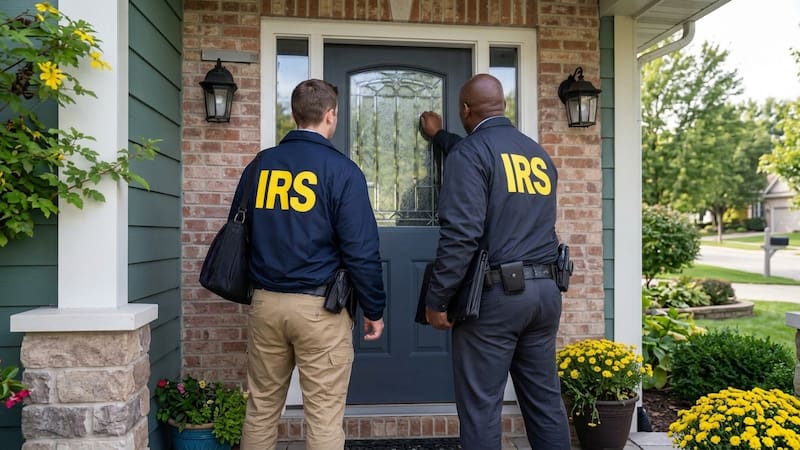
The Internal Revenue Service (IRS) has among its collection mechanisms the possibility of making in-person contact with taxpayers who have unfiled returns or outstanding tax debts.
The possibility of a visit may cause concern among taxpayers in California, Florida, and Texas, especially when there are unresolved tax obligations. However, these powers do not apply only to those three states. These are procedures established by a federal agency and can be applied in different regions of the United States.
Those responsible for intervening in this type of situation are the Revenue Officers, IRS employees who work to resolve accounts with unpaid balances and pending returns. Their duties include contacting taxpayers, explaining the available alternatives, and moving forward with the collection process when appropriate.

In what situations can a Revenue Officer intervene
The intervention of a revenue officer usually occurs when the taxpayer has a tax obligation that remains unresolved. This can include both taxes still due and returns that have not yet been filed.
In-person contact is not necessarily the first step. The IRS says Revenue Officers make several attempts to communicate and, in the usual procedure, use Letter 725-B to set an appointment with the taxpayer.
That communication indicates the date, time, and place of the meeting. The meeting may take place at an IRS office, at the taxpayer’s business, or, in certain circumstances, at their home. It can also be arranged by phone.
Therefore, filing a return late does not mean that a person will automatically receive a visit at home. The intervention depends on the characteristics and status of each case.

California, Florida, and Texas are not the only states affected
The presence of California, Florida, and Texas in this type of situation may draw special attention because of the size of their populations and the number of taxpayers they contain. However, the powers of Revenue Officers stem from IRS federal procedures.
The agency states that these officers generally work within an assigned geographic area, although they may also travel to other areas when they must carry out official duties. Situations contemplated include so-called coordinated field activities.
For this reason, there is no rule that visits or collection actions are limited to those three states. A taxpayer located elsewhere in the country may also become involved if their tax situation requires the intervention of a Revenue Officer.
The IRS no longer normally makes visits without notice
One of the main changes in this procedure occurred in 2023. The IRS then announced the end of most of the unannounced visits made by Revenue Officers.
Since that change, the agency generally uses Letter 725-B to set an appointment before an in-person meeting. The measure was implemented, among other reasons, to reduce confusion caused by scammers posing as agency employees and to improve the safety of taxpayers and employees.
This does not mean that all in-person visits have disappeared. The IRS continues to use face-to-face meetings within its collection processes when they are necessary, but there is usually prior communication.

When an unannounced visit may occur
Unannounced visits were not completely eliminated. The current procedure includes very specific exceptions.
These include certain situations related to the delivery of summonses or subpoenas, seizure actions, and other enforcement procedures. Internal rules also allow an unplanned visit to be evaluated when necessary to protect the Government’s interests, although in certain circumstances the intervention of superiors is required.
For this reason, an unexpected visit from a supposed official should not automatically be interpreted as a routine IRS action. The agency itself says that unannounced visits are rare and recommends carefully verifying the identity of anyone who presents themselves as an employee of the agency.
What can happen if taxes are outstanding
The fact that a Revenue Officer intervenes in a case does not mean the IRS will immediately seize the taxpayer’s assets.
The officer’s role may include analyzing the financial situation, reviewing the outstanding obligations, and seeking an alternative to resolve the debt. Depending on the case, options such as payment agreements or other mechanisms provided for in the collection process may be available.
However, if the debt remains unpaid and the conditions established by the regulations are met, the IRS may move toward more severe collection measures. Among the actions contemplated by the agency are levies on funds, the filing of a federal tax lien, and the seizure of property.
The process includes different notices and stages before certain enforcement measures are reached. Therefore, receiving communication from the IRS or being contacted by a Revenue Officer does not by itself amount to an immediate seizure.
How to recognize a legitimate IRS visit
Taxpayers should also be alert to possible scams. The agency warns that there are people who show up at homes pretending to be IRS employees in order to obtain money or personal information.
Revenue Officers have official identification and, before a routine in-person visit, the IRS generally sends a communication or arranges the meeting. The agency recommends verifying the officer’s details using official channels and, if in doubt, contacting the IRS directly.