
En esta noticia
When choosing a new electric stove, the decision often comes down to two popular options: induction and conventional electric.
Although they may seem very similar, the way they produce and transfer heat is different, which can affect cooking speed, energy consumption, safety, and even the cookware that can be used.
How induction cooktops work
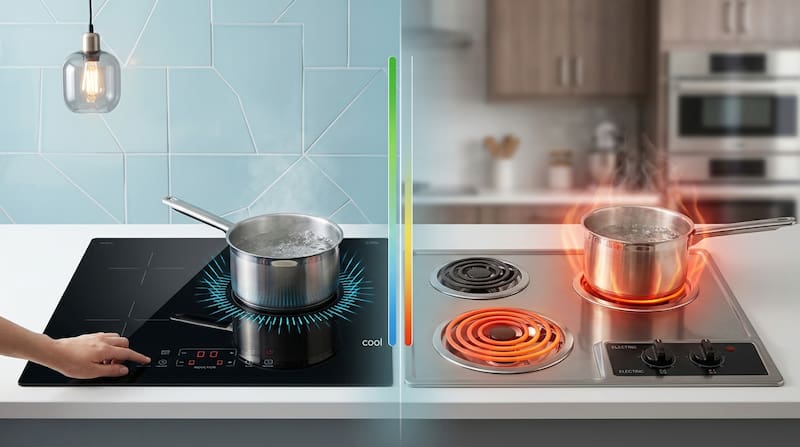
Induction cooktops use electromagnetic energy to heat cookware directly. Coils located beneath the glass surface generate a magnetic field that interacts with compatible pots and pans, producing heat inside the cookware instead of heating the burner first.
One of the main advantages of induction cooking is precisely that direct transfer. Cookware reaches temperature quickly and allows heat to be controlled more rapidly.
Another advantage is energy efficiency. Induction can transfer a greater proportion of the energy directly to the cookware than a conventional electric stove, which can make it more efficient in daily use.
In addition, induction surfaces are usually easy to clean because they are flat and smooth. Since the surface does not heat up in the same way as a conventional electric burner, spilled food is less likely to stick and burn onto the glass.
The disadvantages of induction
The main limitation is cookware compatibility. Induction cooktops need pots and pans made from magnetic materials, such as cast iron or certain types of stainless steel. Aluminum, copper and other materials may not work unless they have been specifically designed for induction.
The initial cost may also be higher than that of a conventional electric stove. Before buying one, it is also advisable to check that the home’s electrical installation is adequate.
How conventional electric cooktops work
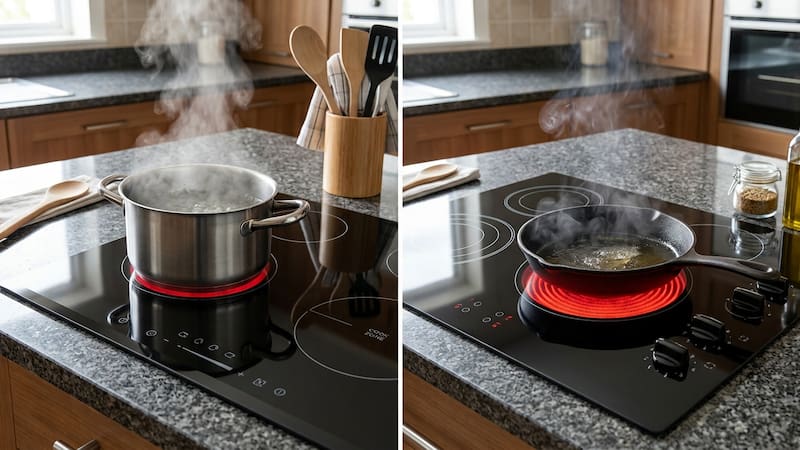
Traditional electric cooktops use heating elements located beneath or within the cooking surface. The element heats up first, and then that heat is transferred to the cookware.
This system is simple and works with a much wider variety of pots and pans. That is why it can be convenient for those who already have different types of cookware and do not want to replace them.
Price is another important advantage. Conventional electric cooktops usually have a lower initial cost, so they can be a practical alternative for those looking to change their stove without making a large investment.
Electricity vs. induction: main differences
Cooking speed
Induction is faster because it transfers energy directly to the cookware. In a conventional electric stove, the element must first heat up before the pan or pot reaches the desired temperature.
Temperature control
Induction also offers faster temperature control. When power is changed, the cookware responds almost immediately because heat is generated directly in it.
By contrast, conventional electric elements retain heat after the power is reduced or turned off, so the temperature change may take longer.
Energy efficiency
If energy efficiency is a priority, induction has the advantage. Its direct transfer system reduces the amount of energy lost between the heating element and the cookware.
However, the real savings on the electricity bill will depend on cooking habits, electricity rates and how often the stove is used.
Safety
Induction cooking also offers an advantage in terms of safety, since the surface does not work in the same way when there is no compatible cookware on it. In addition, it usually stays cooler than a conventional electric surface after cooking.
Traditional electric cooktops, for their part, can remain hot for some time after the heating element is turned off, although many models have automatic shutoff systems.
Cleaning
Both options can have smooth glass surfaces, but induction cooktops usually have an advantage because the surface retains less residual heat. This can make it easier to clean spills and reduce the chance of food residue sticking.
Which stove should you choose?
For those who prioritize speed, temperature control, energy efficiency, and ease of cleaning, induction is usually the most complete option. Its main disadvantages are the higher initial cost and the need to use compatible cookware.
The conventional electric stove may be a better alternative for those looking to spend less upfront, use practically any cookware, and maintain a simple setup. Although it does not offer the same speed or efficiency as induction, it remains a practical and familiar option.
Ultimately, there is no single ideal option for every kitchen. The decision will depend on how much you cook, what cookware you already have, your budget and how much you value reducing energy consumption.