En esta noticia
Deep beneath Kentucky, one of the world’s largest cave systems hides a complex network of underground waterways that cannot be understood simply by looking at the surface. Scientists discovered just how extensive this hidden system was after conducting an experiment with fluorescent dye in 1981.
The investigation focused on Mammoth Cave, a vast underground environment inside Mammoth Cave National Park. Researchers wanted to determine where water entering sinkholes outside the park traveled underground and whether it eventually reached the cave system.
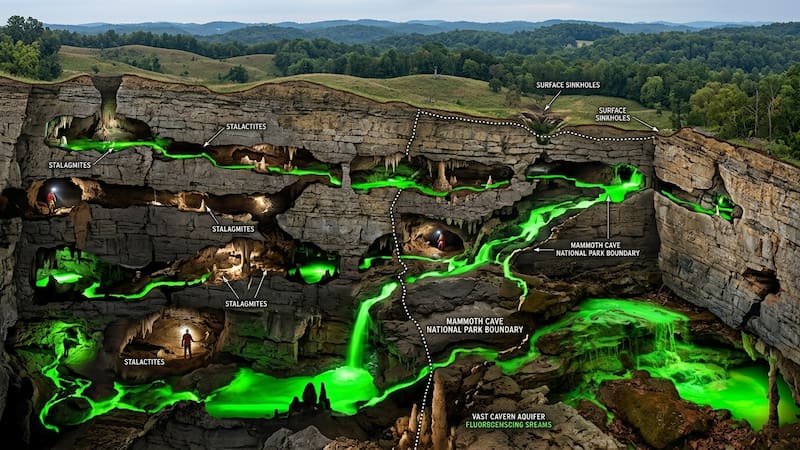
The experiment produced an unexpected finding: approximately 60% of the aquifer associated with Mammoth Cave extends beyond the park’s boundaries.

Scientists used fluorescent dye to follow underground water
The experiment began by placing fluorescent dye into selected sinkholes in Kentucky. Because the dye could be detected in water, researchers were able to track its movement through the underground drainage system.
This technique allowed scientists to establish connections between areas that appear completely separate on the surface. Water entering the ground through sinkholes could travel through cracks, channels and underground passages before emerging in locations connected to Mammoth Cave.
The results demonstrated that the cave’s underground water system was considerably larger than the area protected within the national park.
About 60% of the aquifer extends beyond the park
One of the most important findings was that roughly 60% of the aquifer lies outside Mammoth Cave National Park.
That discovery changed the way scientists viewed the protection of the cave system. Although the park protects the famous caves and the land immediately surrounding them, a large portion of the underground watershed is located on land beyond the park’s borders.
This means that activities occurring outside the protected area can potentially affect the underground water system.
Why the discovery matters
The underground network is particularly important because water is one of the main forces shaping Mammoth Cave. Rainwater enters the ground, moves through the limestone and gradually dissolves the rock, helping create the passages and chambers that make the cave system so extensive.
The same pathways can also transport substances from the surface into underground waterways.
Because a significant portion of the aquifer extends beyond protected land, pollution, agricultural activity, development and other changes at the surface can potentially have consequences underground.
The dye experiment therefore provided more than a map of underground water movement. It also revealed that protecting Mammoth Cave requires understanding what happens far beyond the visible entrances and boundaries of the park.
Mammoth Cave’s hidden plumbing
Mammoth Cave is part of a karst landscape, where soluble rocks such as limestone allow water to create an intricate network of underground channels.
Unlike a conventional river system that can be easily observed from the surface, this network is largely hidden. Sinkholes provide points where surface water can disappear underground, while springs and cave passages can serve as places where that water eventually reappears.
The fluorescent dye offered scientists a way to make these invisible connections detectable.
By observing where the dye traveled, researchers could identify relationships between sinkholes and underground waterways that would otherwise be difficult to establish.

A lesson about protecting underground ecosystems
The 1981 experiment highlighted an important challenge for Mammoth Cave National Park: protecting the cave itself does not necessarily mean protecting the entire system that sustains it.
If much of the aquifer lies outside the park, conservation efforts must also take into account activities taking place on surrounding land.
The discovery helped demonstrate how interconnected underground environments can be and why scientists need to study the areas surrounding protected natural landmarks, not just the landmarks themselves.
What appeared to be a relatively simple experiment — placing fluorescent dye into Kentucky sinkholes and tracking where it went — ultimately revealed a hidden underground system extending well beyond the boundaries of Mammoth Cave National Park.