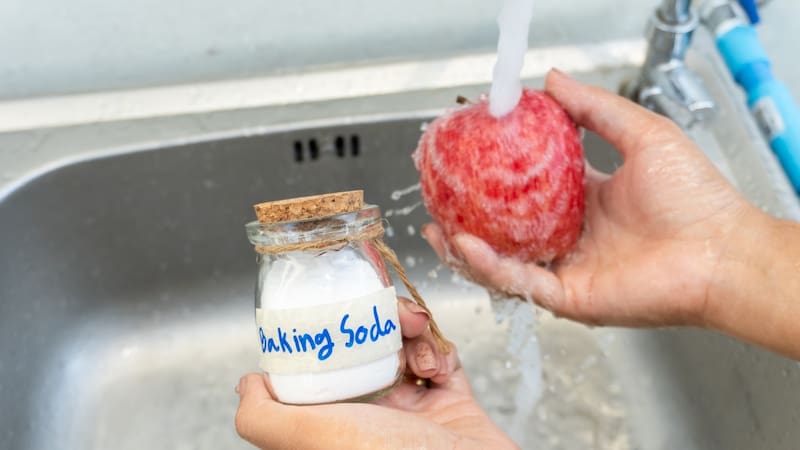

En esta noticia
Apples are one of the fruits that are eaten with their skin on, so their cleaning before eating them is an important step. In addition to removing visible dirt, washing can help reduce some residues that remain on the surface of foods.
A study published in the Journal of Agricultural and Food Chemistry by the American Chemical Society analyzed the effectiveness of different methods for removing pesticide residues from apples. The results showed that a solution of water with baking soda was more effective than plain water at removing certain pesticides from the surface.
The study was published in 2017 and its findings remain a reference for understanding the possibilities and limitations of this method. However, the researchers also found that washing does not remove all residues that may penetrate the fruit.

What soaking apples in water with baking soda is for
The purpose of this procedure is to help reduce residues of certain pesticides present on the surface of apples. Sodium bicarbonate, also known as baking soda, can help break down some of these compounds and make them easier to remove during washing.
The research was led by Tianxi Yang and other specialists, who compared the effectiveness of different cleaning solutions. To analyze the results, they used laboratory techniques that made it possible to study residues both on the surface and inside the fruit.
The results indicated that the bicarbonate solution was more effective than plain water and the bleach solution evaluated in the experiment at reducing surface residues of the two pesticides studied. However, the effect depends on the chemical present and how much of it has penetrated the apple.
What the scientific study found about baking soda
The work, published in October 2017, evaluated two pesticides: thiabendazole and phosmet. The researchers observed that a sodium bicarbonate solution could remove the surface residues of both compounds under the specific conditions of the experiment.
For the test they used a solution with a concentration of 10 milligrams of bicarbonate per milliliter of water. Under those conditions, it took 12 minutes to remove the surface residues of thiabendazole and 15 minutes for those of phosmet.
However, these results do not mean that baking soda removes all pesticides from any apple. The test was carried out with specific substances and under controlled conditions, so it does not allow one to ensure that the same result will be obtained with all products used in agriculture.
Why baking soda does not remove all pesticide residues
One of the main findings of the study was that some residues can penetrate the peel and reach the inside of the fruit. When this happens, washing becomes less effective because the baking soda acts mainly on the compounds that remain on the surface.
The researchers found that thiabendazole penetrated more deeply than phosmet into the peel of the apples analyzed. For that reason, some of the residues could not be removed by washing with baking soda.
The study also noted that peeling the fruit can help remove some residues that penetrated the peel. However, doing so also removes components present in that part of the apple, so the study does not present peeling as a universal solution.
How to wash apples before eating them
The study helps explain why baking soda can be useful for reducing certain surface residues, but it does not establish a formula that guarantees the complete elimination of pesticides in all fruits.
As a routine measure, it is recommended to wash apples with running water before eating them, even when you plan to remove the peel. Washing helps remove dirt and other materials that may remain on the surface.
It is also important to handle the fruit with clean hands and avoid using bleach, detergents, or household cleaning products that are not intended for food. The 2017 study does not show that it is necessary to use baking soda on all apples or that this method replaces standard food hygiene practices.