
En esta noticia
Scientists have reconstructed the face of one of the earliest known representatives of Homo sapiens, offering a striking glimpse at what a member of our species may have looked like more than 300,000 years ago.
The reconstruction is based on fossils discovered at Jebel Irhoud, an archaeological site in Morocco that contains the oldest fossils currently attributed to our species. The remains have been dated to approximately 315,000 years ago, placing them far earlier than many of the fossils traditionally associated with modern humans.
The new facial approximation was created by a team led by Brazilian 3D specialist Cicero Moraes and published in September 2026 in the scientific journal Heritage. Researchers used digital models, anatomical measurements and computer-based reconstruction techniques to recreate the facial structure associated with the Jebel Irhoud fossils.

What did the first Homo sapiens look like?
The resulting face looks surprisingly familiar while also preserving some features that distinguish these early humans from people living today.
The reconstruction shows a prominent brow region, a relatively broad face and other characteristics associated with the Jebel Irhoud fossils. At the same time, the underlying skull had a braincase that was more primitive in shape than that of most modern humans.
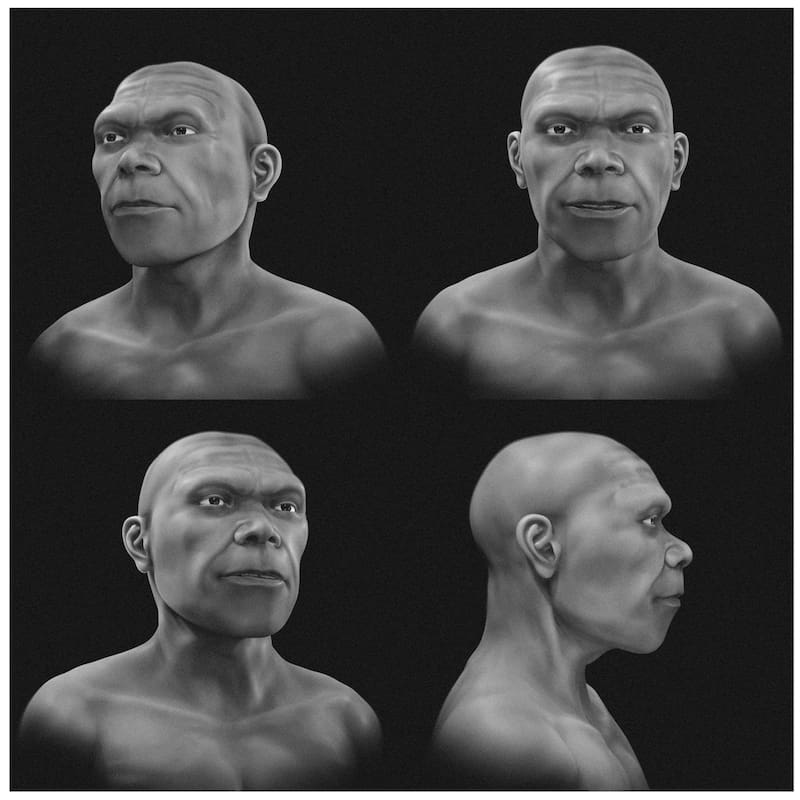
This combination is one of the reasons the fossils are so important to the study of human evolution. The Jebel Irhoud remains display a mixture of modern human facial characteristics and more archaic cranial features, suggesting that the anatomy associated with our species developed gradually rather than appearing all at once.
The researchers also estimated the volume of the reconstructed endocranial cavity at approximately 1,364 milliliters, a figure that falls within the range observed in modern human populations.
The face is a scientific approximation
Despite its photorealistic appearance, the image should not be interpreted as an exact portrait of a person who lived 315,000 years ago.
The researchers worked with a composite skull, meaning the digital model combines anatomical elements from several fossils recovered from the same archaeological layer at Jebel Irhoud. The main component is the Irhoud 1 fossil, discovered in 1961, while other fossil remains were used to complete portions of the jaw, face and teeth.
To reconstruct the soft tissues, the team used a CT scan of an anonymized modern adult and applied anatomical deformation techniques to adapt the modern skull and associated soft-tissue structures to the fossil’s anatomy.
The researchers produced two versions of the result. One is a grayscale reconstruction focused on the anatomical relationship between the fossil and the estimated facial structures. The other is a colored artistic version intended to communicate the reconstruction to a wider audience.
That distinction matters because characteristics such as skin color, hair and facial hair cannot be directly recovered from the fossil. They are artistic interpretations added to make the reconstruction easier to visualize.


Why the Jebel Irhoud fossils changed the story of human evolution
Jebel Irhoud has played a major role in changing scientists’ understanding of when and where Homo sapiens emerged.
The first major discovery at the site was made in 1961, when a skull was uncovered during mining activity. It was initially interpreted as an African form of Neanderthal and was thought to be only about 40,000 years old.
Later discoveries and improved dating methods dramatically changed that interpretation. In 2017, researchers published evidence in Nature identifying the Jebel Irhoud fossils as early Homo sapiens and dating them to approximately 315,000 years ago. That made them the oldest fossils attributed to our species at the time.
The discovery also challenged the idea that modern humans suddenly appeared with all of their characteristic anatomical features in a single region. Instead, the Jebel Irhoud fossils support a more complex picture in which different features associated with Homo sapiens emerged progressively across Africa.
More than three centuries later—wait, more than 300,000 years later—the new reconstruction provides another way to visualize those early members of our species.
It does not show exactly what one individual looked like. Instead, it offers a scientifically constrained approximation of the face associated with some of the oldest known Homo sapiens fossils, bringing one of the earliest chapters of human evolution into view.