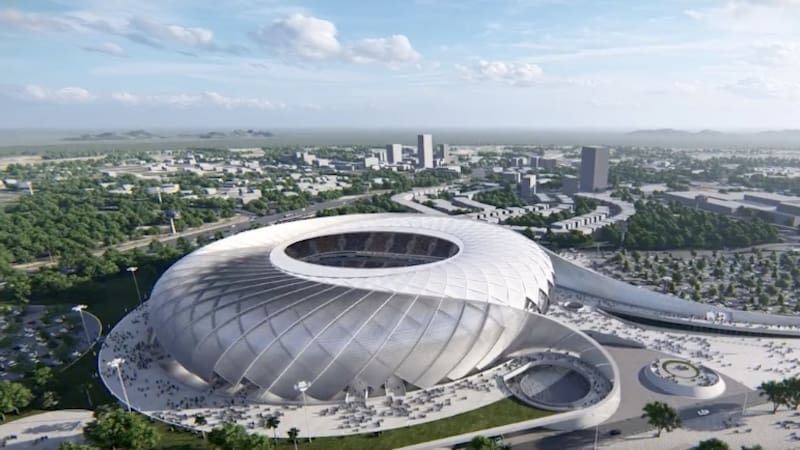
Latin America has great and glorious stadiums, such as Maracanã or Azteca. Now, El Salvador has begun construction on a project that promises to redefine the concept of sports infrastructure in the region: the new National Stadium of El Salvador.
Located in Antiguo Cuscatlán, this project is not just a playing field; it is a cutting-edge structure with capacity for 50,000 spectators seated in individual seats, designed to be the most advanced and sustainable venue in the entire area.

This is what the mega stadium El Salvador is going to build will look like
The new stadium is being built on the grounds that previously housed the Military School, and will cover more than 170,000 square meters. This project stems from a strategic alliance between the Salvadoran government and China, seeking to take advantage of the Asian giant’s technical innovations.
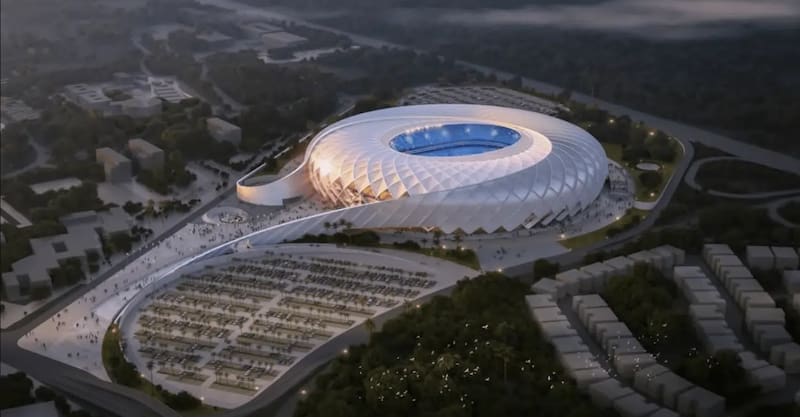
Unlike the heavy structures of the last century, this venue is committed to “harmonious coexistence”. Its design is characterized by curved lines and a modular lattice canopy that creates a natural play of light and shadow, giving a sense of lightness despite its colossal size.
| Dato clave | Detalle del proyecto |
|---|---|
| Ubicación | Antiguo Cuscatlán, El Salvador |
| Capacidad | 50,000 personas (butacas individuales) |
| Superficie | 170,000 m² |
| Estacionamiento | Más de 2,000 vehículos |
| Inauguración | Horizonte hacia el año 2027 |
The true luxury of this work lies not only in its aesthetics, but in its operational intelligence. The stadium will integrate digital management systems to optimize energy and water consumption, positioning itself as a benchmark for ecological architecture in Latin America.

In addition to meeting FIFA’s highest standards for international matches, the complex is designed to be a total entertainment center. The project includes:
- VIP areas and state-of-the-art press rooms.
- Specific areas for festivals and shows on a global scale.
- Adjacent basketball and futsal courts for community use.
- Full accessibility for people with reduced mobility and families.
The project is expected to be completed by 2027 and become one of El Salvador’s architectural prides.