
En esta noticia
The Transportation Security Administration (TSA) confirmed the installation of two new computed tomography (CT) machines at the security checkpoint at Juneau International Airport in Alaska.
From the time they begin operating, passengers passing through this airport will have to put their carry-on personal belongings through this new inspection system.
According to the agency, the technology seeks to strengthen threat detection and, at the same time, speed up travelers’ passage through security checkpoints.

How do the new computed tomography machines work?
The new equipment generates a three-dimensional image of the contents of each traveler’s carry-on luggage .
To do this, it is explained that they use an X-ray camera that takes hundreds of images while rotating around the objects, allowing the contents to be examined from different angles.
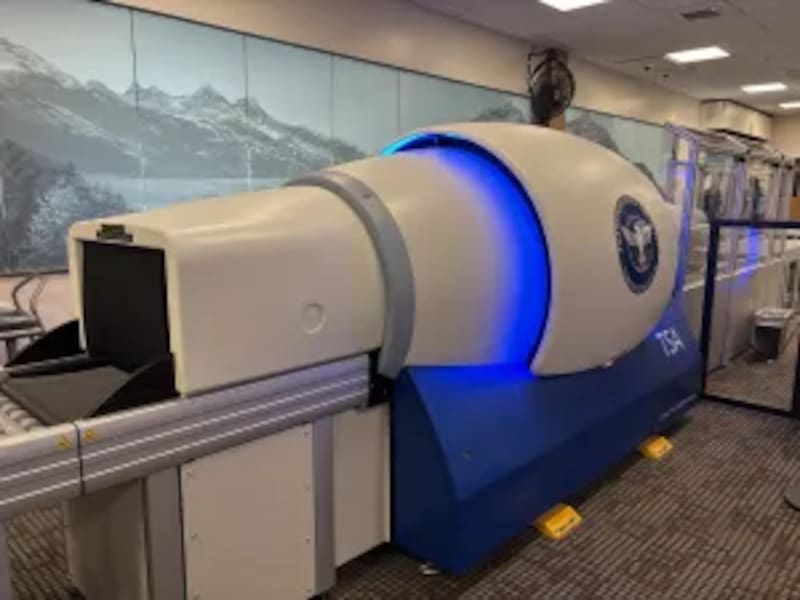
The agency says the system can automatically detect explosives and other items considered dangerous. If any item requiring additional review is identified, an agent will carry out a manual inspection.
What changes for passengers with the addition of these machines
As a result of this implementation, TSA says this technology changes the usual security screening procedure.
Travelers using the lanes equipped with these machines
- Will be able to leave laptops and other electronic devices inside their carry-on luggage
- Will not have to take out travel liquids that comply with the 3-1-1 rule
- Will have to place all carry-on luggage, including wheeled suitcases, inside a bin so it can be inspected by the scanner

The process is expected to then streamline screening for passengers arriving at this terminal.