

An international team of archaeologists confirmed the discovery of a submerged medieval city in Lake Issyk-Kul, in Kyrgyzstan, hidden underwater for more than six centuries. The researchers identified streets, public buildings, and a Muslim cemetery at a depth of just one to four meters.
The work was led by Maxim Menshikov of the Institute of Archaeology of the Russian Academy of Sciences (IARAS). The team surveyed four areas on the lake’s northwestern shore during the autumn of 2025, using divers, underwater drones, and sediment core drilling.

What is the submerged city in Lake Issyk-Kul?
The archaeologists found fired brick walls, a millstone, and decorative fragments that suggest the presence of a mosque, public bath, or madrasa. The scale of the site led the team to conclude that it was a substantial city or commercial center of regional importance.
The settlement would have been part of the Silk Road. UNESCO’s Silk Roads Programme documents that the caravan routes of the Tian Shan linked those valleys with the Issyk-Kul region, transporting silk, metals, ideas, and religions.
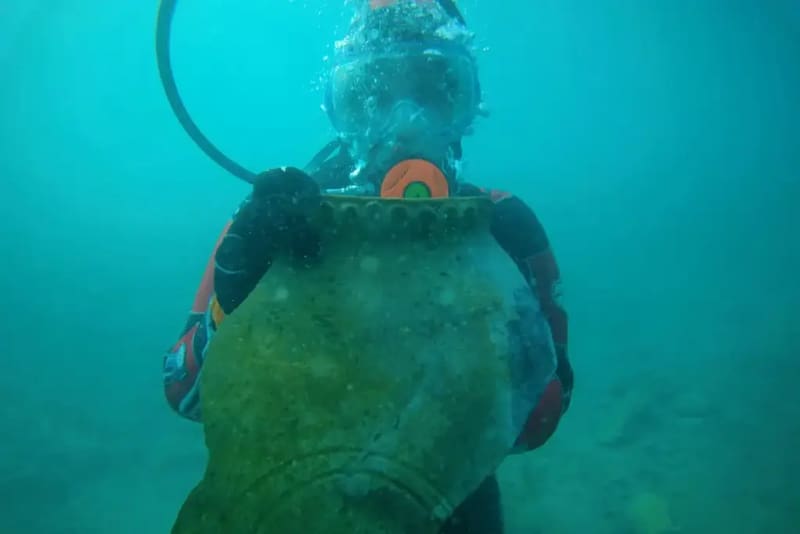
Specialists estimate that a major earthquake in the early years of the 15th century would have sunk the settlement. Lake Issyk-Kul is an endorheic basin—without an outlet river—so any change in water level buried the coastal buildings exactly where divers find them today.
What the divers found
- Zone 1: fired brick walls, a stone mill, and fragments of public buildings
- Zone 2: a necropolis measuring about 300 by 200 meters with graves oriented toward Mecca
- Zones 3 and 4: construction platforms, walls under sediment, and remains of homes
Why is this discovery so important?
The Islamic cemetery is one of the most revealing finds. The bodies were laid on their right side with their faces oriented toward Mecca, a funerary practice characteristic of Islam in the 13th and 14th centuries.
The team recovered the remains of at least one man and one woman for analysis. Wave erosion is already destroying parts of the necropolis, making urgent documentation a scientific priority.
To establish precise dates, the researchers are using dendrochronology—analysis of growth rings in wooden beams—and radiocarbon dating. Both techniques aim to link the city’s disappearance to one of the earthquakes documented in the 15th century.
As the team combines underwater surveys, medieval historical sources, and laboratory dating, the ruins scattered on the lakebed will gradually take the shape of a living city on the Silk Road.