En esta noticia
A group of Argentine researchers developed a sustainable alternative for heating water without having to rely on gas or electricity. The system was built with recycled plastic bottles and low-cost materials, directly harnessing the sun’s energy.
During the tests, the solar water heater managed to raise the water temperature to 42°C after several hours of exposure. The proposal aims to reduce energy consumption and give a second life to everyday plastic waste.

How did they manage to build a water heater with recycled plastic bottles?
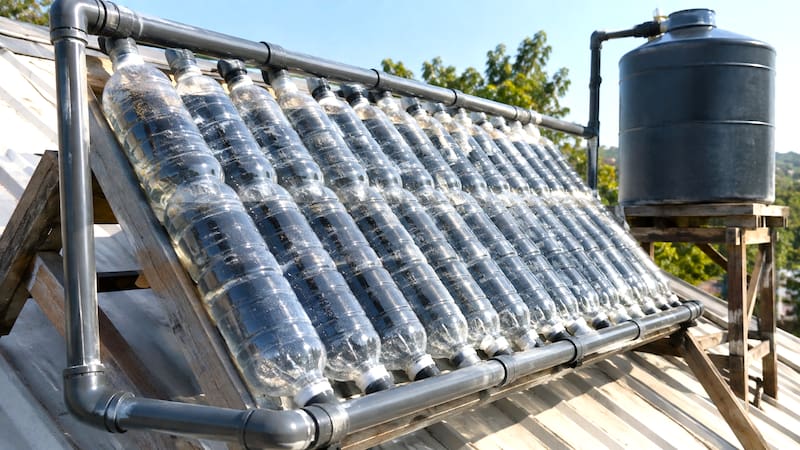
The Argentine researchers, linked to the National Scientific and Technical Research Council (CONICET) in the province of Mendoza, developed an experimental solar water heater using low-cost and recycled materials. The project sought to combine the use of solar energy with the reuse of PET bottles that otherwise could end up as waste.
To build it, they used:
- Recycled PET bottles are placed around the pipes.
- Half-inch polypropylene pipes, painted matte black to better absorb solar radiation.
- Reflective material, responsible for redirecting part of the radiation toward the black tubes.
- Two overlapping bottles for each section, forming a double cover.
In the tests, the system managed to bring the water up to 42°C after 5 hours of solar exposure, even under less-than-ideal conditions.
How does the water heater built with recycled plastic bottles work?
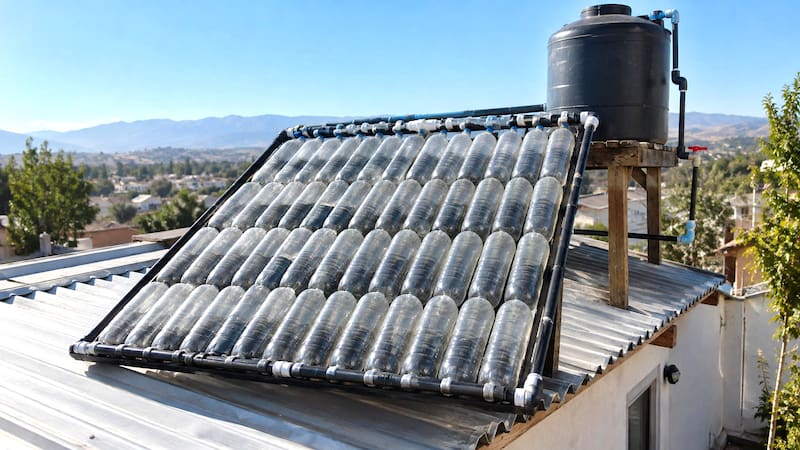
Sun radiation heats the black pipes through which the water flows. The matte black color favors energy absorption and allows the heat to be progressively transferred to the liquid.
The PET bottles do not function as reservoirs: they surround the pipes and create an air chamber that contributes to the technical behavior of the collector, while the reflective material helps direct more radiation toward the pipes.
In this way, the system can produce hot water without using gas or electricity during the heating process, as long as there is sufficient solar radiation.
What limitations does it have, and what are the benefits?
The main benefit is that it allows recycling and renewable energy to be combined. On the one hand, it reuses plastic bottles and reduces the consumption of conventional fuels to heat water. On the other hand, it uses easy-to-obtain materials that are efficient.
Among the main limitations is that performance is not constant, so it cannot be said that it can replace the traditional water heater. The temperature reached depends on many factors, several of which are beyond control, such as the amount of solar radiation and the ambient temperature.