
En esta noticia
During 2026, Zohran Mamdani, the mayor of New York City announced a large number of measures to improve transportation service in one of the busiest areas in the country.
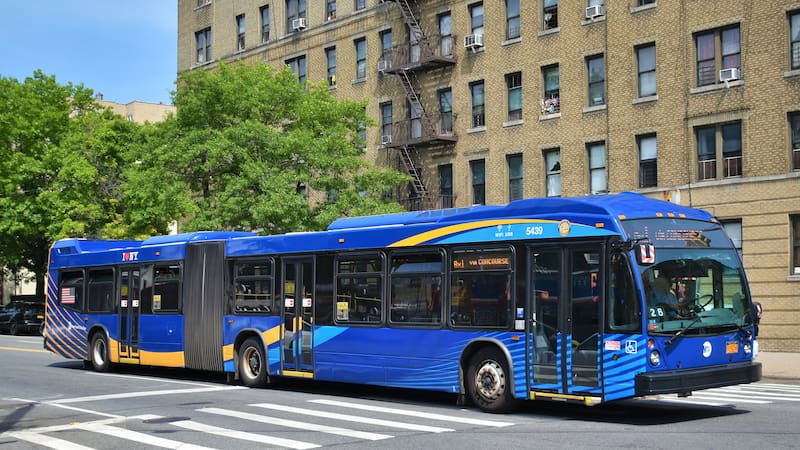
The latest is that he launched the Bronx’s first exclusive corridor, a project on one of the most heavily traveled avenues that seeks to reduce travel times for about 39,000 people who use the Bx36 line daily.
The busway operates every day between 6 a.m. and 8 p.m. and is part of a broader program to speed up bus service in New York City.
Where will the exclusive traffic lane be located in the Bronx?
The new corridor is on Tremont Avenue, one of the Bronx’s main east-west traffic arteries. The project covers approximately one mile of busway and another 0.26 miles of exclusive bus lane.
The configuration changes according to the direction of travel:
- Heading east, the busway extends from Third Avenue to Southern Boulevard.
- Heading west, it runs from Southern Boulevard to Belmont Avenue.
- In addition, between Webster Avenue and Third Avenue, heading east, a shared lane for buses and bicycles was added.
The corridor especially benefits passengers on the Bx36 line, whose buses have been recorded traveling at speeds below 5 miles per hour during periods of heaviest congestion. It also facilitates connections with eight subway lines, Metro-North and other bus services.
Which vehicles will be allowed to travel, and which will have restricted access?
The busway operates seven days a week, from 6 a.m. to 8 p.m. During that period, buses, trucks with six wheels or more, emergency vehicles and Access-A-Ride units may travel the full corridor.
Other vehicles, including taxis, private cars and ride-hailing or transportation service vehicles, may not use the corridor as a through route. They may enter from side streets to make local access, such as dropping off or picking up passengers, but must exit at the next available right turn.
To enforce compliance with these restrictions, the project includes fixed cameras installed along the corridor, cameras mounted on buses and inspections by the New York City Police Department (NYPD).
The new safety changes: Where will they apply?
The New York Department of Transportation (NY DOT) incorporated safety modifications at eight intersections on Tremont Avenue and nearby streets:
- Tremont Avenue and Webster Avenue.
- Tremont Avenue and Third Avenue.
- Tremont Avenue with Southern Boulevard and Crotona Parkway.
- Third Avenue and East 175th Street.
- Southern Boulevard with Crotona Parkway and 180th Street.
- Crotona Avenue and 180th Street.
- Third Avenue and 180th Street.
- Tremont Avenue and Washington Avenue.
Among the main interventions are painted curb extensions, intended to shorten the distance pedestrians must walk to cross and to force drivers to slow down when turning. These areas were reinforced with flexible bollards, granite blocks and bicycle parking spaces, also with the aim of discouraging improper parking.
The program this project is part of: What does Vision Zero propose?
The decision to add these measures responds to the record of crashes on Tremont Avenue, a corridor included among the priority areas of New York’s Vision Zero program. According to data released by city authorities, between 2020 and 2024, about 630 people were injured in traffic crashes and four lost their lives on this stretch.
The redesign aims not only to improve bus speeds, but also to reorganize traffic and reduce conflict points between vehicles, pedestrians and cyclists.
The city also seeks for the reduction in space available for general traffic and the greater delineation of crossings to force drivers to slow down when entering intersections, especially in areas where several avenues converge or there is heavy public transit passenger movement.