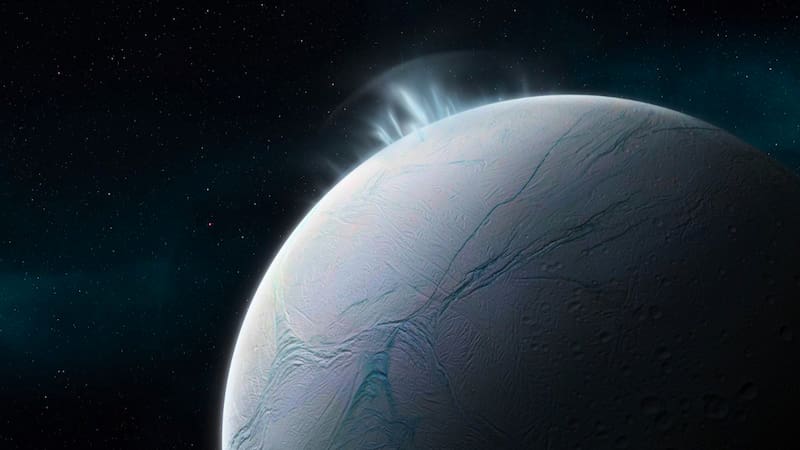

Strictly speaking, life is not on Saturn. If it exists, it hides on one of the planet’s moons, a ball of ice roughly 310 miles across, with a surface where temperatures plunge to 201 degrees below zero Celsius. For more than two centuries, Enceladus was considered an unremarkable satellite of the ringed planet. Today it is one of the strongest candidates in the search for extraterrestrial life.
The reason arrived this week from Germany. A team led by William Orsi, a professor of geomicrobiology at Ludwig-Maximilian University in Munich, managed to keep microbes from Earth’s deep waters alive in a laboratory brine that mimics the ocean hidden beneath the moon’s icy crust.
An alien ocean in miniature
No one has ever seen that underground sea, so the scientists had to build one. They mixed water, salts, carbonates and powdered rock to reproduce both the strong alkalinity and the reactions between water and rocky seafloor believed to occur on the moon. Those reactions generated hydrogen, just as is suspected to happen on Enceladus.
Into that broth they introduced the test subjects: Methanothermococcus okinawensis, a microorganism native to the hydrothermal vents of the Okinawa Trough, between Japan and Taiwan. It is a methanogen: it lives on hydrogen and carbon dioxide rather than oxygen, a gas that is scarce on Enceladus. It converts those ingredients into methane.
The pH 11 surprise
The result surprised the researchers themselves. The microbes grew in a brine with a pH of 11, well beyond the limits previously documented for these strains, and they also adapted their metabolism to make use of the scarce dissolved carbon dioxide.
One detail makes the coincidence even more tantalizing. NASA’s Cassini probe detected methane in the plumes of particles that Enceladus vents from its south pole, the same gas these organisms produce.
Enthusiasm, but with caution
Specialists outside the work greeted it with interest. David Rothery, a professor of planetary geosciences, argues that showing methanogenesis is viable under conditions similar to those on Enceladus removes another obstacle to the existence of microbial life there.
The limits of the experiment are clear. Surviving in a flask does not prove there is life on the moon. Orsi himself warned that if life did develop on Enceladus, it could be very different from life on Earth. Nor can it be ruled out that the methane has a purely geological origin.
The story is completed by a second finding. According to coverage of the study, the moon’s plumes naturally concentrate the ocean’s components into distinct ice particles, which would make it easier to detect biological signals on future missions.