En esta noticia
The oven trays and baking sheets often accumulate over time a layer of burnt grease that seems impossible to remove. Although soap can remove surface dirt, the brown stains that remain after years of use require a different method.
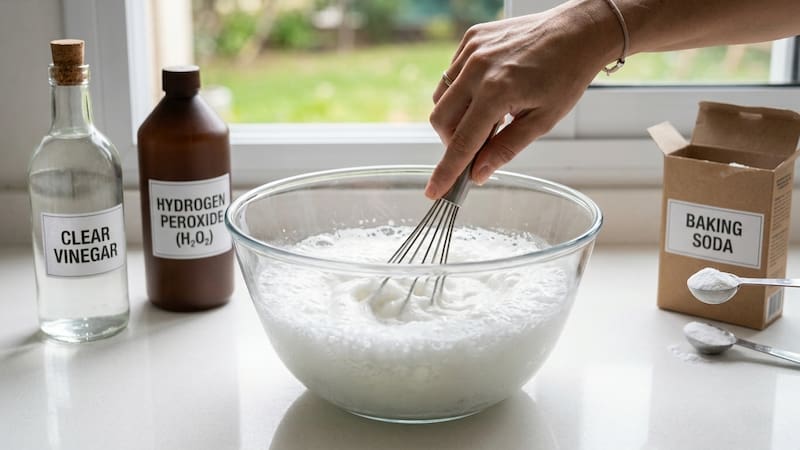
A homemade alternative uses products that many people already have at home: baking soda, hydrogen peroxide, and white vinegar. However, there is an important clarification: it is not about mixing the three ingredients at the same time.
The recommendation is to use baking soda with hydrogen peroxide or baking soda with vinegar as separate methods to treat stuck-on grease.
Why is burnt grease so hard to remove?
The problem with oven trays is not always simply accumulated dirt. When the oils used for cooking are repeatedly subjected to high temperatures, they can turn into a hardened layer known as polymerized grease.
This substance adheres directly to the metal and takes on a varnish-like texture. That is why conventional detergent may be insufficient: it is mainly designed to remove surface grease, but has difficulty penetrating this hardened layer.
In addition, using overly aggressive metal scrubbers can create small scratches on the surface and make grease stick more easily in the future.
Baking soda and hydrogen peroxide: a combination for the toughest grease
For the most difficult buildup, one of the proposed alternatives is to prepare a paste with baking soda and hydrogen peroxide.
The indicated preparation uses half a cup of baking soda and between two and three tablespoons of hydrogen peroxide. Both ingredients should be mixed until they reach a toothpaste-like consistency.
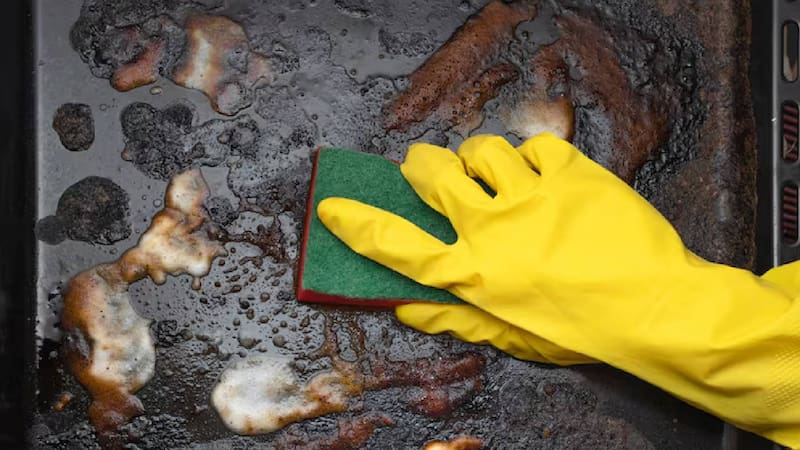
Then, the mixture is spread over the areas where the burnt grease is found and left to work for a maximum of 20 minutes.
The peroxide provides an oxidizing reaction that can help loosen the residue, while the baking soda particles help dislodge the dirt when it is time to scrub.
After the waiting time, it is recommended to use a non-scratch sponge to gently remove the remaining residue. On stainless steel trays, the advice is to scrub following the direction of the metal grain. Finally, rinse very well with warm water and dry.
Baking soda and vinegar to remove stubborn residue
There is another method that does without hydrogen peroxide and uses baking soda and distilled white vinegar.
In this case, first a thick paste is prepared by mixing baking soda with a small amount of water. The preparation is placed directly on the dry tray and left to sit for at least 20 minutes.
Baking soda has an alkaline character and, together with its slightly abrasive texture, helps loosen the adhered grease layer. Then, the surface is scrubbed with a sponge to remove the residue.
Once most of the dirt has been removed, white vinegar can be applied to any residue left behind. The effervescent reaction helps lift the paste and makes rinsing easier afterward.
Finally, the tray must be rinsed with warm water until all residue is completely removed.
Should the three products be mixed?
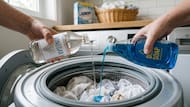
No. This point is fundamental. The source’s recommendation is not to prepare a single mixture with baking soda, hydrogen peroxide, and vinegar. In reality, it presents different cleaning alternatives.
One option combines baking soda and hydrogen peroxide, especially for significant grease buildup. Another uses baking soda, water, and then vinegar to help loosen the remaining residue.
Therefore, if you want to reproduce the method, the most suitable thing is to choose one of the alternatives rather than combining all the ingredients in the same container.
Combining the three ingredients at the same time can be dangerous, so it is not recommended to mix them.
Which trays can be cleaned with these methods?
The technique with baking soda and hydrogen peroxide is indicated in the source for uncoated aluminum trays or stainless steel trays.
In the case of aluminum, it is important to monitor the process to prevent the surface from discoloring. It is also recommended to avoid excessively abrasive tools that could create scratches.
The choice of method should also depend on the material and finish of the tray. If the container has a nonstick coating, it is advisable to consult the manufacturer’s instructions before applying abrasive products or carrying out a deep cleaning.